
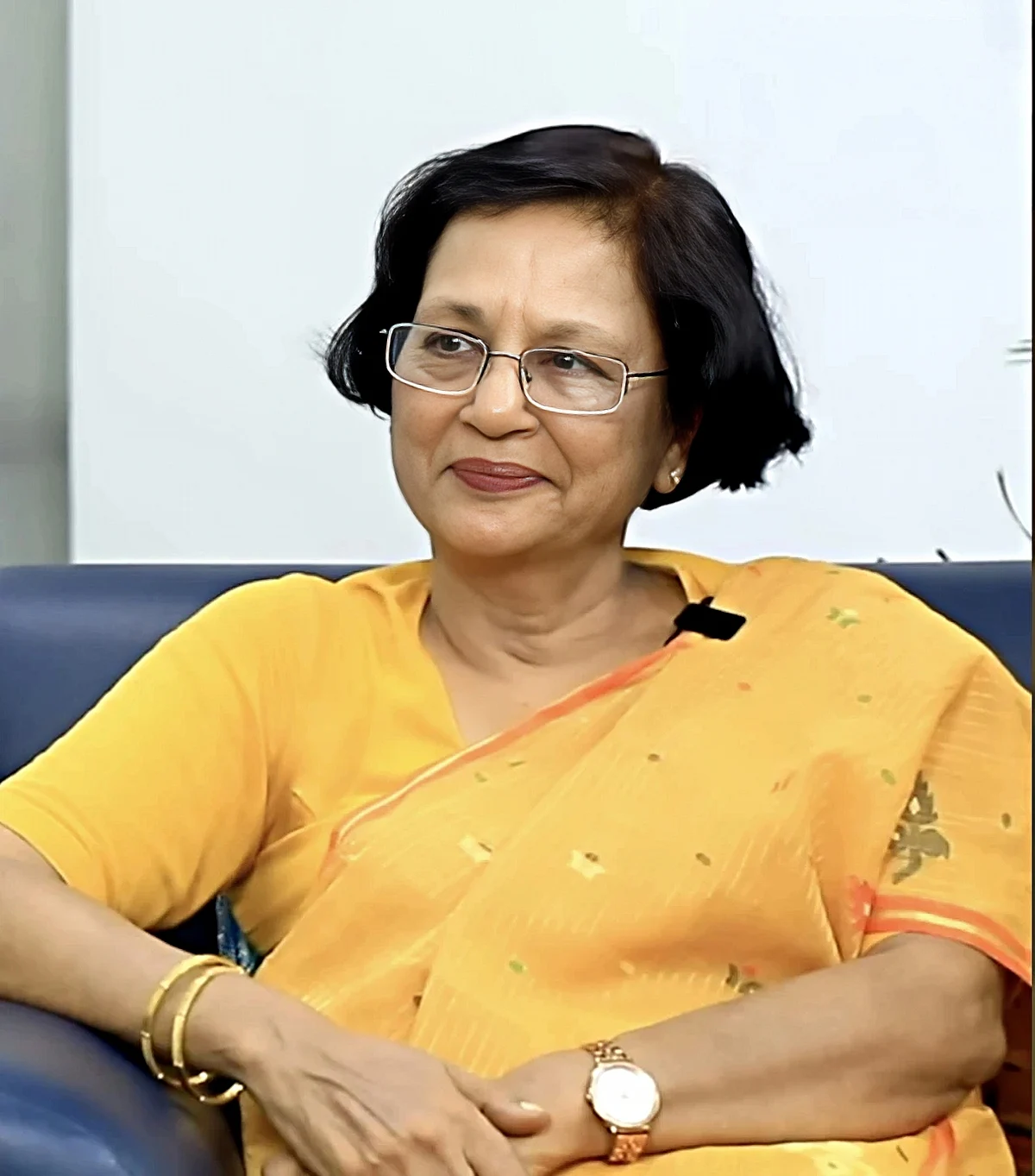
Dr. Meenakshi Jain: The Brave Historian
A historian of Conviction, Courage, and Civilisational Clarity

Poonam Sharma
At a time when Indian historiography was dominated by Marxist accounts that darkened Bharatiya civilization with distorted, grim colors, Dr. Meenakshi Jain stood out as a voice of absolute integrity, academic genius, and unflinching truth-telling. Her decades-long battle for historical truth was awarded its rightful national enshrinement on July 14, 2025, when she was nominated to the Rajya Sabha by the Hon’ble President of India—a distinction which is richly earned as well as symbolically profound.
A Scholar with Spine
Padma Shri recipient Dr. Meenakshi Jain is not the typical scholar. A one-time Associate Professor of History in Gargi College, Delhi University, she declined to follow the well-trodden path of ideological uniformity. Instead, she challenged the mainstream version of history—consolidated and zealously protected by the so-called “eminent historians” of Marxist orientation—and elected to take them on using rigorous research and civilisational understanding.
Her academic work tears down the well-entrenched scholarly dogmas which have, for decades, misrepresented India’s history. There is no bitterness in her words and writings—only lucidity, exactness, and a deeply felt sense of obligation to reveal what really happened to Bharat through centuries of invasions, colonisation, and ideological manipulation.
Rewriting the Narrative, Truthfully
Dr. Jain’s books are like weapons of intellectual liberation. All of them are challenges to the established orthodoxy of post-independence Indian historiography. Her 2016 book, “Sati: Evangelicals, Baptist Missionaries, and the Changing Colonial Discourse,” was a searing indictment of how colonial powers used native customs—specifically sati—to establish moral grounds for imperial domination. The book revealed how missionary fervor, and not humanitarianism, informed the colonial discourse, vilifying Hindu traditions for geopolitical objectives.
In “The Battle for Rama: Case of the Temple at Ayodhya”, she presented what is widely regarded as the definitive counter-narrative to the Leftist denial of Ram Janmabhoomi’s historicity. Unlike ideological tracts disguised as academic writing, Jain’s work is based on archaeological, textual, and testimonial data. It transformed public and scholarly perceptions of the Ayodhya dispute by vindicating the silent majority who felt betrayed for so long by intellectual elites.
Her magnum opus, “Flight of Deities and Rebirth of Temples,” is a heart-wrenching yet triumphant account of how Hindu deities were desecrated, their temples destroyed, and yet, how dharma resurrected itself over and over. It documents episodes of destruction and spiritual resistance with clinical precision and a compassionate civilisational lens—a feat few historians have ever achieved.
Some of her other works including “Rama and Ayodhya,” “Vasudeva Krishna and Mathura,” and “Parallel Pathways: Essays on Hindu-Muslim Relations” establish her allegiance to primary sources, fidelity to texts, and interpretative balance. Her editorial work in “The India They Saw” (Volumes I–IV) brings together pre-colonial foreign descriptions of India that refute colonial and Marxist stereotypes of a backward, divided country.
Silenced by the Establishment
Dr. Jain’s most significant experience with academic censorship was her NCERT history textbook for Class XI, part of the brief attempt to rectify ideological imbalance in school history. The book, which was well-received for its candour and seriousness, was starkly withdrawn as soon as the ideological pendulum shifted back to the Left. The episode merely contributed to her stature as a conscientious scholar who refused to compromise.
Unlike her ideological adversaries, she never practiced political activism or polemics. Her reply was in the form of pages, not protests. Her writing was her resistance—and it has endured.
A Legacy of Intellectual Brilliance
Dr. Meenakshi Jain is from a line of deep thinkers. Her father, Shri Giri Lal Jain, was a legendary editor of The Times of India whose sharp analyses were founded on Indian civilisational ethos. Her sister, Sandhya Jain, is an author and commentator in her own right, with books delving into Indic politics, tradition, and global civilisational clashes.
This intellectualism in the family is not decorative—it is the basis for her strength. When faced with scorn in academic communities or muzzling by publishing lobbies, she trusted not in institutional networks but in the power of argument and the perspicuity of her evidence.
Dr. Jain’s nomination to the Rajya Sabha is more than individual achievement—it’s a statement of civilisation. It is the Indian Republic at last recognising a scholar who has devoted her life to making sure that the Sanatan civilisational memory does not die with the impact of distortions.
Her presence in Parliament can provide a vital intellectual balance to the ideological prejudices that still shape policy, education, and cultural debate. She goes into the House not as a historian, but as guardian of India’s historical conscience, prepared to speak with the same measured authority that has characterized her life.
The Road Ahead
In a moment when India is poised to regain its civilisational self-respect, Dr. Meenakshi Jain’s promotion is symbolic and pragmatic. Symbolic, as it establishes the role of truth-tellers in national life in India. Pragmatic, as her academic experience can now influence national policy on education, preservation of heritage, and cultural revitalisation.
In an era of superficial social media commentary and politicized academic verbiage, Dr. Jain is a reminder that authentic scholarship does not require hashtags or protests—rather, it requires courage, rigour, and passion for one’s civilisation.
A Salute to the Silent Warrior
Dr. Jain has never pursued limelight, never solicited approval from the very cabals that she had nailed. But it is very much this unspoken strength that earns her such regard. She enters India’s Upper House of Parliament with the aspirations of innumerable students, scholars, and patriots who feel that history can never be kept a battleground of deceit, but a reflection of truth.
Congratulations, Meenakshi Ji.
May your voice now echo not just through your books—but through the very halls of India’s
