
Bhagwant Mann’s Blunders Mirror Punjab’s Political Deterioration
Cracks in the AAP Fortress

Poonam Sharma
Punjab’s politics is poised to enter a decisive period in 2025 with the governing Aam Aadmi Party (AAP), who was once celebrated as the change-maker, being pushed into a corner. The most recent political flare-up stems not from within the state, but from Chief Minister Bhagwant Mann’s ill-advised remarks about Prime Minister Narendra Modi’s foreign tours—comments that have drawn rebuke from both the Centre and opposition parties. This episode is merely the latest of a string of gaffes and inconsistencies that betray a greater issue: The government of Punjab is beginning to show signs of structural collapse, and the Mann administration is losing political capital at a rapid rate.
Bhagwant Mann’s Undiplomatic Attack on PM Modi
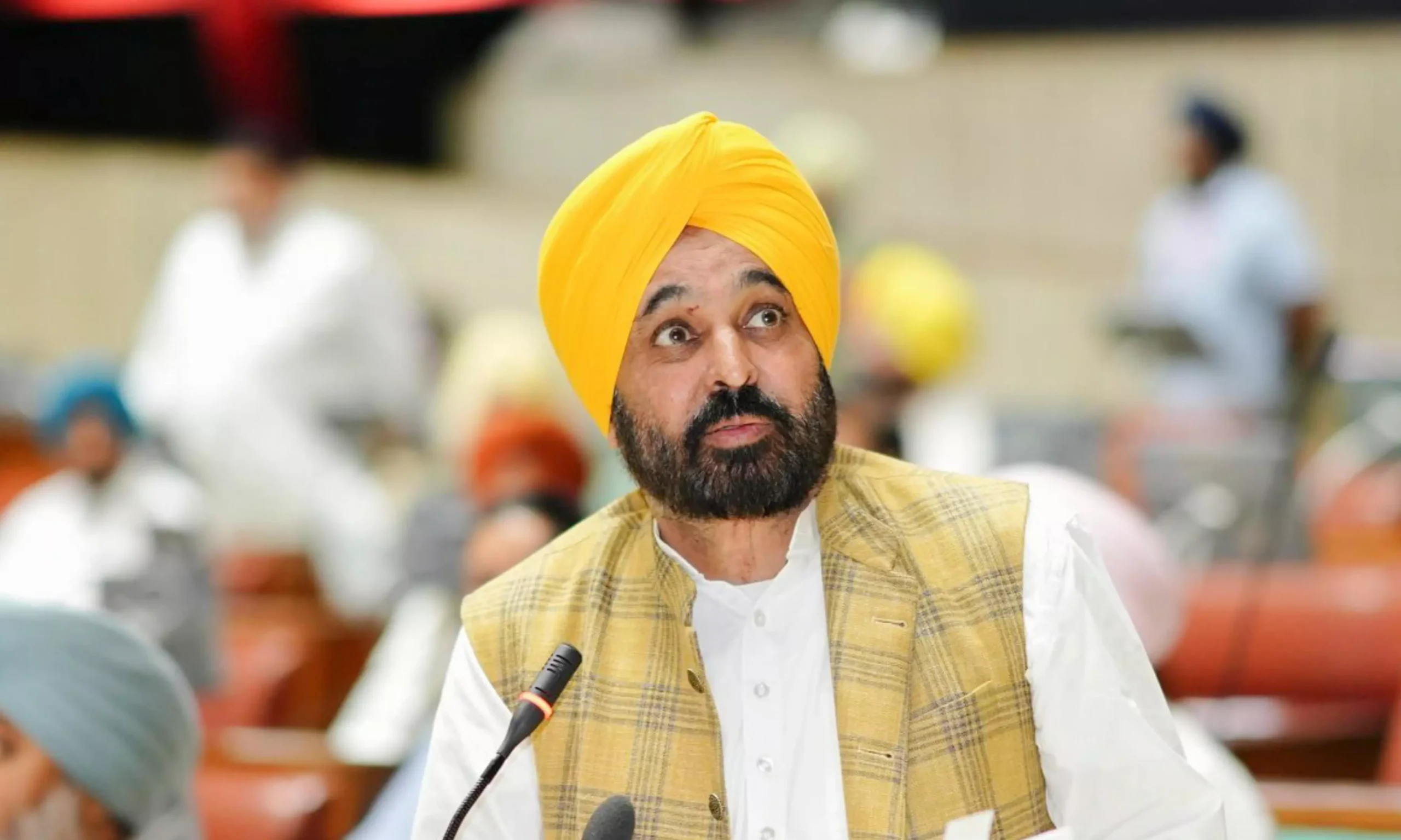
CM Bhagwant Mann, while addressing the media, ridiculed Prime Minister Modi’s recent five-nation tour to Ghana, Trinidad and Tobago, Argentina, Brussels, and Namibia. Mann dismissed these nations as “tiny countries” and sarcastically said that in India, even 10,000 people gather to watch a JCB machine at work—implying that Modi’s visits abroad lacked significance or impact. This comment was not only diplomatically irresponsible but also revealed a startling lack of understanding of India’s geopolitical strategy.
The Ministry of External Affairs (MEA) issued a rare rebuke, calling Mann’s comments “regrettable and irresponsible,” clearly distancing itself from such rhetoric. The MEA highlighted that Modi’s visit was a landmark in India’s diplomacy, culminating in the Prime Minister being awarded the highest civilian honors by Ghana, Trinidad and Tobago, and Namibia. These countries, while small in population, are critical to India’s outreach to the Global South, diaspora engagement, and economic diversification.
Mann’s remarks not only undermined his credibility at the national level but also showed an uncalled provocation towards the central government. The CM of a state struggling with serious law-and-order problems, economic stress, and farmer agitation, should rather be concerned with internal governance rather than ridiculing India’s foreign policy—a sphere far beyond his area of authority.
A Government Under Siege: AAP Losing Control in Punjab
Even prior to this diplomatic row, Bhagwant Mann’s government had been under severe attack from all sides. The interesting thing about the current political situation is that both the BJP and the Congress are now united in their attack on the AAP government in Punjab—a rarity in Indian politics.
Punjab Congress chief Raja Warring, delivering a biting criticism in the Assembly, held Mann guilty of giving the same speech for three years. Warring claimed that Mann’s speeches were devoid of content, vision, and urgency while Punjab grapples with mounting gang violence, drug smuggling, agrarian crisis, and economic stagnation.
From the BJP side, there has been strong exception taken to the inability of the Mann government to check terrorism-related activities, using the instance of smuggling mobile phones to imprisoned terrorists in Karnataka (Parappana Agrahara jail case), one that raised questions about state coordination failure and prejudiced AAP’s image as a national governing party.
In addition, BJP spokesmen have also highlighted deteriorating internal security in Punjab with recent gang shootouts, increasing cases of extortion, and a virtual collapse of the criminal justice system in some parts of the state. The reasoning is straightforward: while Mann is engaged in attacking the Centre, his own state is going berserk.
Why Is Mann Provoking Delhi?
One could argue that Mann’s repeated jibes at the Modi government are strategic. AAP, led by Arvind Kejriwal, has built its identity on opposing the BJP. However, there is a difference between principled opposition and reckless provocation. Mann’s statement on PM Modi’s diplomatic engagements crosses that line and puts India’s foreign relations at risk.
This also represents a pattern of deflection—instead of dealing with Punjab’s internal problems, Mann and the party leaders tend to play to the gallery with sensational comments directed towards the Centre. This ploy might be effective at election rallies, but it is rapidly losing popularity with Punjab’s voters, who are increasingly worried about serious issues such as job generation, drug abuse, and farmer suicides.
Congress and BJP Finding Common Ground
The opposition solidarity against AAP in Punjab is significant. Congress charges Mann with being “all show and no substance,” while BJP calls him a “CM in name only,” remotely controlled by Arvind Kejriwal in Delhi. The recent criticism by Congress leaders also pointed at Mann’s inability to offer any new plan to address Punjab’s water problem, merely repeating the old slogan that “Punjab has no surplus water” without providing actionable solutions.
Interestingly, Congress has also taken umbrage at Mann’s insult against convent-educated politicians, questioning if learning in English-medium schools is now a crime. Such populistic talk, aimed at evoking rural voters, is now starting to ring hollow and divisive, even for AAP’s own supporters.
What Lies Ahead for Punjab?
Punjab’s political mood is now suffused with frustration, exhaustion, and fear. The AAP government has been unable to fulfill its high-flying promises of a “new Punjab.” Rather than checking corruption, ending unemployment, and enhancing public security, it is stuck in a vicious circle of PR war, media management, and confrontation with the centre.
Bhagwant Mann’s declining credibility is an alarm bell—not only for AAP in Punjab, but for its ambitions at the national level. The Centre, on the other hand, cannot afford to ignore such taunts indefinitely, particularly when they come close to tarnishing India’s global reputation.
The Crumbling Façade
AAP in Punjab is also going through a crisis of governance, leadership, and relatability. The party’s habit of self-projecting as the sole clean alternative is being undermined by the reality of things: escalating crime, farmer agitation, water conflicts, and now, irresponsible foreign policy analysis.
With BJP and Congress joining hands in their onslaught, and popular sentiment changing, the Mann government needs to acknowledge that headline politics cannot replace actual governance. If it fails to adjust soon, the AAP’s “Punjab model” could collapse under the gravity of its own contradictions—revealing a weak structure constructed more on theatrics than statecraft.
