
17 Speeches, One Message: PM Modi’s Global Bharat Moment

Paromita Das
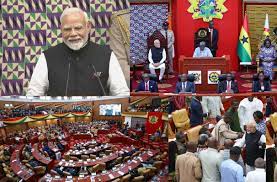
New Delhi, 11th July: When Prime Minister Narendra Modi rose to speak before Namibia’s National Assembly this year, he didn’t just add another milestone to his list of international accolades — he quietly sealed a chapter of Bharat’s diplomatic history that generations before him could barely imagine. With this, PM Modi’s 17th Parliament speech abroad placed him on par with the combined record of all Congress Prime Ministers put together — and he did it in just over a decade.
It was not just the content of his speech, or the standing ovation that followed in Windhoek’s Parliament, but the deeper signal it sent: Bharat’s voice is now not only heard — it is respected, sought after, and celebrated even in nations many dismiss as “small” but that hold untapped diplomatic weight in the Global South.
A Prime Minister Who Knows How to Speak — and Be Heard
In the realm of statecraft, symbolism matters as much as policy. PM Modi’s string of foreign Parliament addresses — from Australia and the US to Ghana, Trinidad & Tobago, and now Namibia — shows how Bharat under his leadership has refused to see diplomacy as mere protocol.

When PM Modi rose to greet Namibian lawmakers in their native Oshiwambo, he wasn’t ticking a ceremonial box — he was bridging a cultural ocean, reminding Namibians that Bharat remembers their freedom struggle, just as they remember Bharat’s support when it mattered.
Each of these 17 speeches, including this one in Windhoek, has turned the world’s gaze to Bharat’s evolving narrative: an ancient civilisation that is unafraid to engage, shape, and lead in a changing world.
Why Small Countries Matter in a Big World
For some, the applause in a hall in Namibia might seem trivial in the age of global giants and big-ticket summits. But the power of Modi’s message lies in where he chooses to take Bharat’s voice. Ghana, Trinidad & Tobago, Palau, Dominica, Papua New Guinea — none are global economic superpowers, yet all are vital cogs in the Global South.

Modi’s approach is deliberate: he wants Bharat to be seen as a partner that listens, not dictates; that builds, not extracts. His Namibia speech was rich with reminders of this principle — praising Africa’s right to value addition, warning against resource exploitation, and highlighting Bharat’s readiness to support clean energy, digital payments, and healthcare infrastructure.
Where China often takes, Bharat aims to share. That difference, spoken from the floor of Parliaments often overlooked by the West, matters.
A Long List of Honors, but a Larger Message
Namibia didn’t just host PM Modi’s words — it honored him with its highest civilian award, the Order of the Most Ancient Welwitschia Mirabilis. Named after a hardy desert plant, the decoration is a symbol of resilience and rare distinction. Modi joins a small, exclusive club of global leaders who have collected such international recognition at this scale.

Yet, the real prize isn’t the medal itself — it is what it represents: a leader whose personal stature has strengthened Bharat’s collective standing abroad.
A Statesman’s Signature on Bharat’s Global Page
One can debate Modi’s domestic politics — it’s the nature of democracy. But on the international stage, his record of foreign Parliament speeches and accolades is undeniable. These moments are not just about him; they are about an Bharat confident enough to stand shoulder to shoulder with old allies and new friends alike.

His words resonate beyond Parliament walls. When he says, “Let our children inherit not just freedom but the future we build together,” he’s reminding the world that Bharat’s development is tied to global prosperity — a promise that Bharat’s rise does not come at another’s cost.
Beyond the Applause
As Modi’s 17th Parliament address echoes from Windhoek to New Delhi, its significance goes beyond a leader’s personal triumph. It is a statement that Bharat’s soft power is no longer a theory in diplomatic white papers — it is a living, applauded reality.
For Bharat, this is about setting the tone for how a rising power should behave: with humility, partnership, and an unwavering belief that history can be made — not just by standing on grand global stages, but by speaking in places the world has long ignored.
In the end, the claps in Namibia remind us that a speech is never just words. Sometimes, it’s the signature of a new Bharat on the page of the world.
