

Poonam Sharma
India’s legal landscape has long been a complex battleground for balancing personal laws rooted in religion with constitutional mandates on equality, justice, and human dignity. Among the most scrutinized and debated arenas is Muslim Personal Law. While religious freedoms are protected under the Indian Constitution, successive landmark judgments and legislative efforts have highlighted a determined push towards protecting Muslim women’s rights, often surpassing the protections available in many Muslim-majority nations. Through a series of progressive rulings, the Indian judiciary and government have taken significant steps to uphold gender justice and reform discriminatory practices within the Muslim community.
Judicial Interventions: A Roadmap Toward Equality
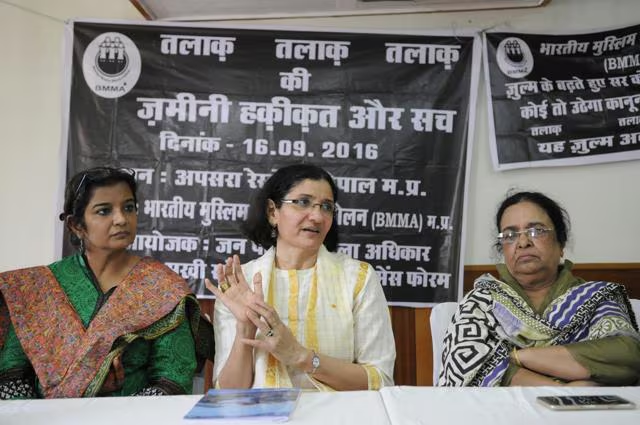
The judiciary has played a transformative role in advancing Muslim women’s rights, particularly in the realm of marriage, divorce, maintenance, and guardianship. In Shayara Bano v. Union of India (2017), the Supreme Court struck down the regressive practice of talaq-e-biddat or instant triple talaq. By a 3:2 majority, the Court held that this form of divorce was arbitrary and violated fundamental rights under Articles 14, 19, and 21 of the Constitution. This landmark verdict wasn’t merely symbolic — it became the catalyst for the Muslim Women (Protection of Rights on Marriage) Act, 2019, criminalizing instant triple talaq and offering tangible legal protection to Muslim women.
Earlier, the Danial Latifi v. Union of India (2001) ruling served as a counterbalance to the controversial post-Shah Bano 1986 law that many saw as regressive. The court interpreted the statute in a manner that required Muslim husbands to make a “reasonable and fair provision” for their divorced wives that extended beyond the iddat period. This harmonization of personal law with constitutional guarantees showed judicial sensitivity and a commitment to gender justice.
Procedural Fairness in Divorce and Custody
In Shamim Ara v. State of U.P. (2002), the court reiterated the importance of procedure in Islamic divorce, stating that a mere mention of “talaq” was insufficient. A valid divorce required a clear declaration, reasonable cause, and an attempt at reconciliation — a move aimed at curbing arbitrary, one-sided divorces. Similarly, in Chand Patel v. Bismillah Begum (2008), the court addressed irregular marriages and affirmed children’s rights to inheritance, reinforcing the idea that children should not suffer due to procedural lapses of their parents.
These rulings collectively emphasize the judiciary’s proactive stance in ensuring that due process and fairness underpin all personal law proceedings, protecting women from sudden and unjust marital breakdowns.
Guardianship and Child Welfare
The courts have also made remarkable strides in expanding the rights of Muslim mothers, especially in guardianship and child custody matters. The Gohar Begam v. Suggi alias Nazma Begam (1959) case acknowledged the mother’s right as the natural guardian of her illegitimate child — a progressive verdict even by modern standards. Similarly, in Noor Sabha Khatoon v. Md. Quasim (1997), the apex court ruled that children from Muslim marriages are entitled to maintenance under Section 125 of the Criminal Procedure Code (CrPC), not just under religious laws. This ensured a safety net for children irrespective of the personal law governing them.
Pushing the Boundaries: Uniform Civil Code and Reform
In Sarla Mudgal v. Union of India (1995), the court addressed the misuse of conversion by Hindu men to contract second marriages under the guise of Islam. The judgment emphasized the necessity for a Uniform Civil Code (UCC) as envisioned under Article 44 of the Constitution. Though UCC remains a politically sensitive topic, the verdict highlighted the dangers of legal pluralism when exploited for personal gain and reiterated the need for coherent, religion-neutral family laws.
Likewise, the Ahmedabad Women Action Group v. Union of India (1997), while not resulting in immediate reform, kept the window open for judicial scrutiny of polygamy and unequal inheritance under Muslim Personal Law. It signaled a cautious but clear intention of the judiciary to bring religious practices under the purview of constitutional morality.
Government’s Role in Legal and Social Reform
While judicial activism laid the groundwork, the government’s legislative initiatives have cemented these changes. The enactment of the 2019 Act against triple talaq is a prime example. For the first time, Muslim women had clear legal recourse against a practice that had tormented generations. Moreover, the government’s schemes like Nai Roshni (leadership training for minority women), Beti Bachao, Beti Padhao, and initiatives for education and skill development among minority women underscore a broader policy vision to integrate Muslim women into the national mainstream.
Compared to many Islamic countries, where male-dominated interpretations of Sharia often restrict women’s rights, India’s legal system provides Muslim women with far greater access to justice, recourse against arbitrary divorce, and provisions for maintenance, education, and inheritance.
A Quiet but Steady Revolution
India’s legal system, through a calibrated mix of judicial interpretation and legislative intervention, has significantly improved the lives of Muslim women. While challenges remain — including social conservatism, community backlash, and lack of awareness — the direction of change is unmistakable.
Muslim women in India today enjoy more enforceable rights than many of their counterparts in the Islamic world. The Indian judiciary deserves credit for challenging archaic norms while respecting religious sentiments, and the government has shown resolve in backing these judgments with legislative support. Together, they represent a quiet but steady revolution — one that continues to push the boundaries of gender justice within the framework of a secular democracy.
