
Ajay Yadav Lynching: Bihar’s Political Hypocrisy Under Fire

Paromita Das
New Delhi, 9th July: In the sweltering July heat of Motihari, a small town that rarely finds itself splashed across national headlines, the tragic tale of Ajay Yadav has forced Bihar to confront its ugliest truths once more. At thirty-two, Ajay had no idea that stepping out to witness a Muharram Tazia procession would end with him sprawled lifeless on the dusty road, surrounded by the echoes of frenzied chants and the cold indifference of leaders who claim to speak for people like him.
A Procession Turned into a Nightmare
Motihari’s narrow lanes have seen many Muharram processions over decades—some peaceful, others tense but uneventful. This year was different. What began as a religious ritual morphed into an armed mob, their lathis and swords turning the streets into a battleground. Hindu locals, Ajay among them, became targets in an outburst of rage that few had anticipated but many now claim could have been prevented.
As news of Ajay’s brutal death spread, shock gave way to anger. Social media lit up with questions. Where were the police? How did swords and rods become part of a religious event? And most importantly, why was the state’s political leadership silent?
Tejashwi’s Silence: An Echo from the Past
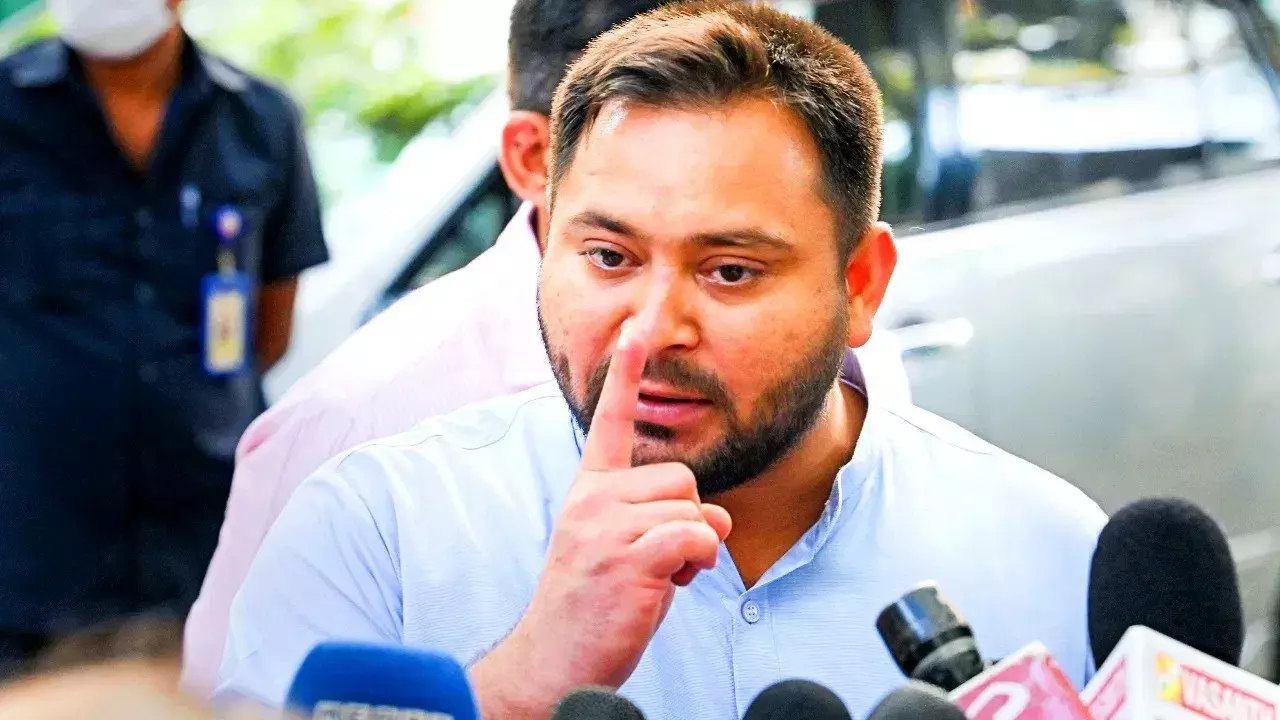
Silence can be more deafening than slogans. Just hours before Ajay was beaten to death, Tejashwi Yadav, the face of Bihar’s Rashtriya Janata Dal, found time to evoke the spirit of Mohammad Shahabuddin—a name synonymous with terror in Bihar’s badlands. Standing on the RJD’s Foundation Day stage, Tejashwi’s words—“Shahabuddin ji zindabad”—rang out like an old ghost’s whisper returning to haunt a new generation.
Many hoped that Tejashwi, educated and polished, would help RJD shed its old baggage of gangsters and musclemen. Yet, here he was, glorifying a man convicted for murders and extortion, while a young Yadav lay dead with no word of condemnation from the party’s top leader. To call this political hypocrisy is an understatement—it is a betrayal of the very community that the RJD once claimed as its pillar.
The Broken Bridge of the ‘MY’ Formula
The Muslim-Yadav (MY) alliance once crafted by Lalu Prasad Yadav was pitched as a bridge between communities that had long felt marginalized. For years, it delivered votes and, for a while, even delivered hope. But Ajay Yadav’s lynching exposes how that bridge now creaks under the weight of selective empathy.
The uncomfortable truth is that Tejashwi’s silence may not be accidental. Condemning the attackers, allegedly from the minority community, risks upsetting a carefully balanced vote bank. The political calculus is brutal—better to lose a few angry Yadav votes than alienate a bloc that could swing entire constituencies.
Appeasement: A Dangerous Game
Bihar’s history of communal clashes during Muharram is well documented. Year after year, there are reports of stone pelting and skirmishes. Yet, leaders across the spectrum often look away, afraid to offend religious sentiments that translate into electoral arithmetic.
Tejashwi has, in the past, positioned himself as a champion of minority causes, whether by rejecting the Waqf Amendment Bill or lending implicit support to demands for Sharia-centric autonomy. But in doing so, he risks emboldening those who misuse faith as a cover for violence. Ajay Yadav’s death is proof that appeasement, when left unchecked, has a bloody cost.
A State Held Hostage by Shadows
By invoking Shahabuddin, Tejashwi signalled not a break from the past but a chilling continuity with an era when muscle power ruled Bihar’s streets. Shahabuddin, even in death, casts a long shadow over Siwan, Motihari, and now, the entire state’s fragile peace. His name is not just nostalgia for old RJD loyalists—it is a reminder that fear and politics have always walked hand in hand in Bihar.
The tragedy here is not just that Ajay Yadav died. It’s that his murder has been folded into a narrative of silence and complicity. Instead of standing up for law and order, Bihar’s leaders appear trapped in a cycle where criminals are heroes and victims are statistics.
What Bihar Deserves
In my view, Bihar deserves better. It deserves leaders who do not play both sides, who do not glorify crime one moment and hide behind silence the next. Communities deserve to know that when their sons are slaughtered on the streets, their leaders will speak for them—loudly and without fear of losing votes.
The ‘MY’ formula needs reinvention, not as a divisive wedge but as a genuine bridge for progress and security for all. The youth of Bihar, both Muslim and Yadav, want jobs, roads, schools, and safety—not hashtags for criminals and half-hearted tweets when blood spills on the streets.
When Silence is Complicity
Ajay Yadav’s lynching must not fade from memory as just another communal clash statistic. It must stand as a reminder that silence can be complicity, that glorifying criminals can embolden mobs, and that appeasement has real victims.
If Tejashwi Yadav truly wishes to lead Bihar into a brighter, safer future, he must choose—between ghosts of Shahabuddin and the living dreams of Ajay Yadav’s generation. Until then, Bihar’s people must keep asking the hard questions and demand a politics that values life over votes, truth over tactics, and justice over slogans.
