
Bharat’s Africa Moment: Modi’s Ghana Address Marks a Turning Point for the Global South

Paromita Das
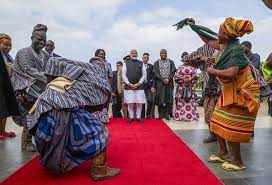
New Delhi, 8th July: In an era of shifting world orders and contested influence, Prime Minister Narendra Modi’s landmark address to the Parliament of Ghana stands out as more than a ceremonial first — it is a signal flare of Bharat’s rising diplomatic ambition in Africa. On a warm Thursday in Accra, the echoes of Modi’s words filled a hall that hadn’t seen an Bharatiya Prime Minister in over three decades. Yet the message he carried spoke not just to Ghana but to the wider Global South: the world’s balance must change — and Africa must stand tall at the table where decisions are made.
A Speech that Resonated Beyond Accra
Standing before Ghana’s lawmakers, Modi spoke with a conviction that went beyond mere protocol. “The world cannot afford to ignore the Global South anymore,” he declared, drawing nods and applause in equal measure. For decades, Africa — a continent bursting with resources, talent, and promise — has been treated as an afterthought by the old custodians of global power. Modi’s speech challenged that old script, reminding the world that during Bharat’s G20 presidency, it was not just rhetoric but action that counted — and the African Union’s inclusion as a permanent G20 member is proof.
Such gestures, while symbolic, have real weight. They signal Bharat’s intent to stand alongside Africa as an equal partner — not a patron, nor an opportunist. In many ways, Modi’s Ghana visit stitched together threads of history, solidarity, and new-age diplomacy into one powerful message: Africa’s rise and Bharat’s rise can — and must — run parallel.
From Words to Action: Agreements that Matter
Modi’s visit wasn’t just about words echoing through parliamentary walls. Bharat and Ghana inked multiple agreements that touch the heart of development: research, healthcare, pharmaceuticals, technology, and cultural exchange. For a continent where the fight for affordable medicines and technological empowerment is far from over, Bharat’s promise carries weight.
Crucially, Modi made it clear that Bharat’s partnership comes without the heavy baggage that often follows big-power investments — no backroom deals, no hidden debts. “Our development partnership with Africa is guided by your priorities and aims to empower rather than impose,” he said. This subtle yet clear contrast to other global players resonates with African nations that have sometimes felt cornered by one-sided deals and extractive partnerships.
A Tribute Rooted in History
The diplomatic charm offensive did not forget symbolism. Modi paid tribute to Dr. Kwame Nkrumah, Ghana’s founding father and an icon of Africa’s decolonization. By standing before Nkrumah’s memorial, Modi was reminding both Bharatiya and Africans of a time when freedom movements flowed across borders — when Bharat’s independence in 1947 inspired many African leaders to break their own colonial chains.
“Our friendship is older than our flags,” Modi might well have said — and the sentiment would not have been misplaced.
Celebrating Shared Stories
Tucked into the statecraft was a lighter, human touch. Modi spoke fondly of the Bharatiya diaspora in Ghana — a community that has lived and worked in harmony for generations. His pineapple metaphor — “sweeter than your famous sugar-coated pineapples” — drew laughter and warm smiles, reminding everyone that diplomacy, too, needs moments of gentle humour to stitch hearts closer.
A Symbolic Honour and a Strategic Signal
No visit of this magnitude is complete without an honour — and Ghana’s highest civilian award bestowed on Modi was more than just a medal pinned to a suit. It was a nod to Bharat’s growing soft power, its deepening ties with Africa, and the shared hope that this bond can reshape how the Global South is treated by the Global North.
As he accepted the honour, Modi pledged Bharat’s enduring support in areas that matter most: digital public infrastructure, agriculture, education, clean energy. In many ways, this mirrors Bharat’s domestic priorities — and it’s telling that these priorities now echo across continents.
A New Road for the Global South
Skeptics will ask: what does a speech in Accra change? They miss the bigger point. Words don’t move mountains, but they do chart new roads. By standing before Ghana’s Parliament and calling for an inclusive, reformed global order, Bharat reminded the world — and itself — that moral leadership still matters. For far too long, the world’s economic engines have ignored the voices of the Global South. If Bharat’s outreach is sustained, respectful, and free of arrogance, it can be the bridge that helps Africa stake its rightful claim on the global stage.
Not Just a Visit, But a Vision
Prime Minister Modi’s Ghana address was not about protocol or pageantry alone. It was a statement of intent that Bharat and Africa can shape a fairer world order together — not by clinging to old hierarchies, but by rewriting them. In a world often divided into blocs and interests, Bharat’s message in Accra rings clear: solidarity, not supremacy, will decide who truly leads in the decades to come.
