
Priyank Kharge’s Call to Ban RSS: Politics of Distraction or Ideological Stand?

Paromita Das
New Delhi, 3rd July: In Bharat’s crowded political theatre, controversy is never far behind. But sometimes, the timing of a statement can reveal more than its words. Karnataka Minister Priyank Kharge’s recent call to ban the Rashtriya Swayamsevak Sangh (RSS) is one such moment — a political spark that may end up burning its own camp more than the intended target.
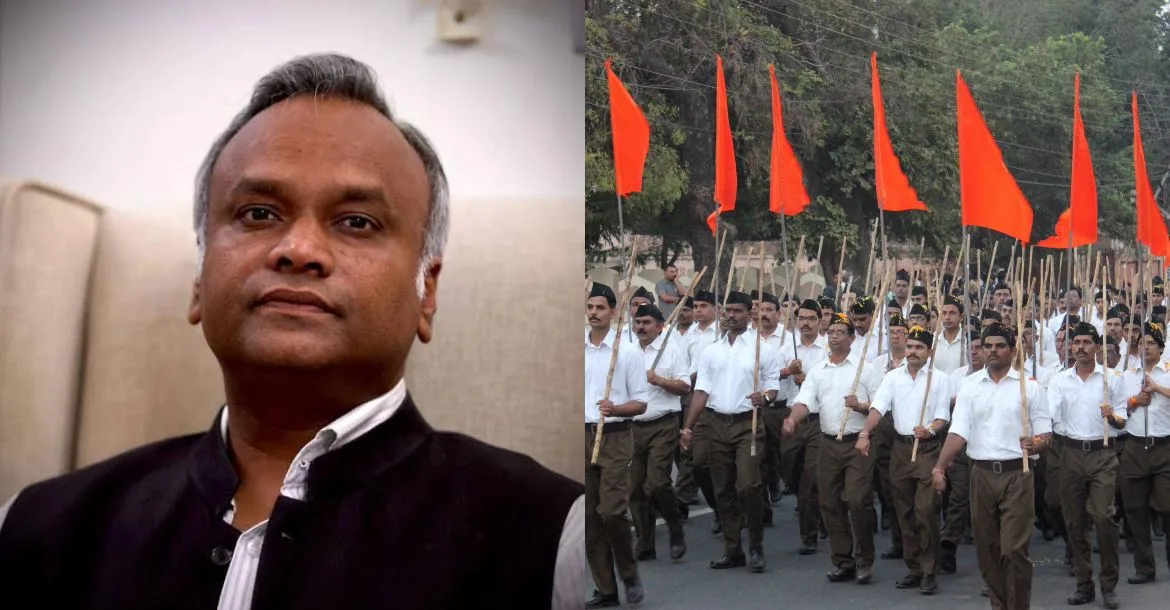
As the son of Congress national president Mallikarjun Kharge, Priyank’s voice carries more than the usual weight of a state-level leader. By branding the RSS as a threat to the Constitution, he has stirred a pot that has long simmered in Bharatiya politics. Yet the question that arises is not just about whether the RSS deserves to be banned — but why the Congress chooses to revive this demand now, when it has its own house to put in order.
A Familiar Enemy, A Familiar Playbook
This is not the first time the Congress has clashed openly with the RSS. The relationship between the grand old party and the country’s largest cultural-nationalist organisation has always been uneasy, if not openly hostile. The Gandhi assassination, the Emergency, the Babri Masjid demolition — each moment of national crisis saw the Congress point fingers at the RSS, sometimes with bans that lasted months or years.
Yet every attempt to outlaw the RSS has ended the same way: the organisation emerged not weaker, but stronger, its martyr image polished by what its followers see as political vendetta. For millions, the RSS is not a political threat but an embodiment of Hindu identity and grassroots service. To brand it unconstitutional is to risk branding a huge swathe of Bharat’s conservative base as suspect — a move that has repeatedly cost the Congress more than it has gained.
What’s Really at Stake in Karnataka?
Why rake up this old ghost now? Karnataka politics may offer some clues. The Congress government in the state is battling more than the BJP — it’s wrestling with itself. Rumours of rivalry between Chief Minister Siddaramaiah and his deputy D.K. Shivakumar refuse to die down. Power-sharing headaches, unfulfilled promises, and factional undercurrents have kept the Congress on the defensive since its big win last year.
Priyank Kharge’s fresh salvo against the RSS, critics say, is less about ideological clarity and more about tactical misdirection. By picking a fight with an ideological opponent as big as the RSS, the Congress hopes to shift the conversation away from its own simmering disputes. For Priyank’s father, Mallikarjun Kharge — already struggling to hold together a party of restless factions — the distraction may be convenient.
A Risky Game with Familiar Consequences
Yet here lies the risk. Every time the Congress leans too heavily on old ideological battles, it risks appearing stuck in the past. More damaging still is the perception that it is fighting Hindu identity itself — a charge its opponents never tire of repeating. The BJP and RSS have, for decades, shaped this narrative: that the Congress stands for minorities alone, that it mocks Hindu pride, that it is uncomfortable with Bharat’s cultural majority. Whether fair or not, this line has stuck — partly because the Congress keeps giving it fresh life.
The party’s repeated alliances with groups like the Indian Union Muslim League only sharpen this perception. By renewing the RSS ban talk, the Congress may please a slice of its secular, liberal base. But in a country where Hindu sentiment is deeply woven into the social fabric, it risks alienating many more.
More Governance, Less Grandstanding
At its core, politics is not about fighting old ghosts but solving new problems. Karnataka has plenty: job creation, farmer distress, urban infrastructure gaps, and the constant tug-of-war of local power plays. A strong, united Congress would focus on governing well, delivering welfare on time, and presenting itself as a credible alternative to the BJP’s narrative. Banning the RSS will not fix potholes, put money in farmers’ pockets, or resolve leadership quarrels.
For Priyank Kharge, the gamble is clear — shift the headlines, rally the faithful, and buy time for the party’s internal wounds to heal. But if recent history is any guide, the strategy may backfire. The more the Congress leans on fighting the RSS to hide its own fractures, the more it risks proving its critics right.
In the end, the Congress’s challenge is not the shadow of the RSS but the shadow of its own indecision. If it wishes to revive its fortunes, it must banish distractions and focus on what it still promises — a party that can govern, not just grandstand.
