
Caught Red-Handed: F-35 India Exposed US Espionage Game
India’s Message to Superpowers: You Can’t Violate Our Skies Anymore

Poonam Sharma
Spy Games in the Skies: India Grounds American Tactics
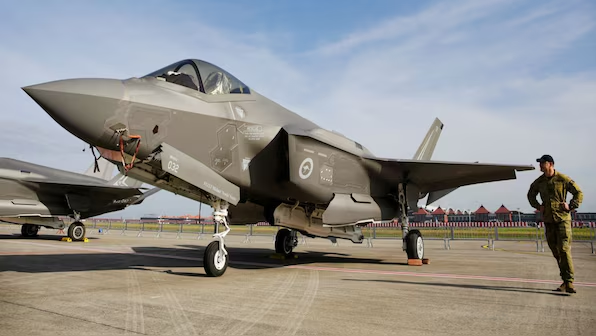
In an unprecedented and dramatic turn of events, an American-origin F-35 stealth fighter jet made an emergency landing in Kerala, triggering a high-voltage geopolitical standoff. While initially termed a “technical emergency” by the US and UK authorities, Indian intelligence and defence sources have revealed a far more sinister angle — this was no ordinary emergency; this was a full-blown aerial espionage mission aimed at penetrating India’s critical airspace.
The F-35, widely regarded as the most advanced fifth-generation stealth combat aircraft, is built to avoid radar detection and carry out covert missions — including deep surveillance. However, Indian radar systems marked and tracked the jet as it entered the air corridor over the southern coast. Its abrupt and unauthorized descent on Indian soil raised immediate red flags in the Indian Air Force command centers. Within minutes, Indian security agencies had scrambled teams and taken full custody of the aircraft, denying any foreign intervention in its assessment.
UK’s Failed Diplomacy and America’s Denied Access
Soon after the incident, the United Kingdom attempted to dispatch its own defence expert team to examine the aircraft, under the pretext of joint NATO ownership and shared technology protocols. However, India refused to allow any British personnel to touch the aircraft, citing national security concerns. The British team was told in clear diplomatic terms: “India will conduct a full, independent investigation under its own protocols.”
The UK, reportedly pressured by American defence contractors and intelligence outfits, pushed further but was rebuffed. Indian defence officials reiterated that any forensic analysis, technical disassembly, and system interrogation would be done strictly by Indian personnel. The British team was politely but firmly sent back.
Following this, the United States officially requested to send its expert investigation team to assess the situation, retrieve onboard mission data, and gain access to the highly sensitive black box of the aircraft. Once again, India stood its ground.
India’s Bold Stand: No Black Box, No Bargains
In a significant policy move, India refused to grant direct access to either the aircraft or its systems. New Delhi asserted that either the black box be handed over to Indian experts or the data be decrypted and examined entirely in Indian presence.
The US, surprisingly, denied both conditions — raising suspicions even further. If this were truly a harmless emergency landing due to a technical glitch, why hide mission data? Why refuse Indian supervision?
Indian analysts now believe that the F-35 was on a spy mission — possibly mapping sensitive military infrastructure or collecting electronic intelligence (ELINT) across the subcontinent. The way both the US and UK satellites began tracking the aircraft the moment it landed also strengthens this theory. The entire episode appears to have been orchestrated to test or exploit India’s air defence weaknesses — a mission that failed spectacularly.
Technological Triumph: India’s Radar System Nails Stealth Jet
The biggest takeaway from this diplomatic drama is not just the exposure of a suspected espionage mission — it is India’s silent technological victory. The F-35 is engineered to evade most radar systems globally, including legacy Russian systems. Yet, India’s upgraded, indigenously modified radar grid not only detected but continuously tracked the aircraft till its unexpected descent.
This technological feat sends a strong message to global powers: India is not the weak link in Asia’s defence chain. Far from it — India’s capacity to intercept a US stealth aircraft and force its landing shows how the regional balance of power is quietly shifting.
Espionage and Trust Deficit Between Allies
What’s deeply ironic — and alarming — is that the US and UK, while calling India a “strategic partner,” are now caught red-handed attempting to snoop on Indian territory. This fractures trust and will have long-term diplomatic consequences.
Defence analysts are also questioning the motives behind such an operation. Was it to monitor Indian nuclear or space installations? Or was it a data-harvesting run to assess India’s defence grid before upcoming regional changes — especially with tensions rising in the Indo-Pacific?
Whatever the reasons, the act represents a breach of faith — one India is unlikely to forget or forgive easily.
What Happens Next?
With the aircraft now secured and sealed under Indian jurisdiction, a thorough probe is already underway. Indian engineers and intelligence experts are dissecting systems, assessing software logs, and ensuring that no sensitive data is leaked back to the US.
Reports suggest that the entire maintenance and recovery process will be handled by Indian private defence firms in coordination with DRDO. Every part, every cable, every data point will be catalogued and reviewed. Not a single component will leave Indian soil without clearance.
Moreover, India is preparing to charge the US for all logistical, security, and parking costs incurred during this unexpected landing. Sources indicate that India will also seek damages for breach of airspace and unauthorized military movement.
A Strategic Turning Point
This is not just about a plane. This is about sovereignty, technological confidence, and geopolitical self-respect. America’s F-35, their pride and spy-machine, was caught and grounded — not by China, not by Russia, but by India.
As Washington and London face the embarrassment of failed espionage and diplomatic stonewalling, India’s stature rises — silently but surely. A new global balance is emerging, and New Delhi is asserting that it will no longer be a passive observer.
This is a warning — not just to the US, but to any nation considering covert games in South Asia: India is watching, India is ready.
