

By Anjali Sharma
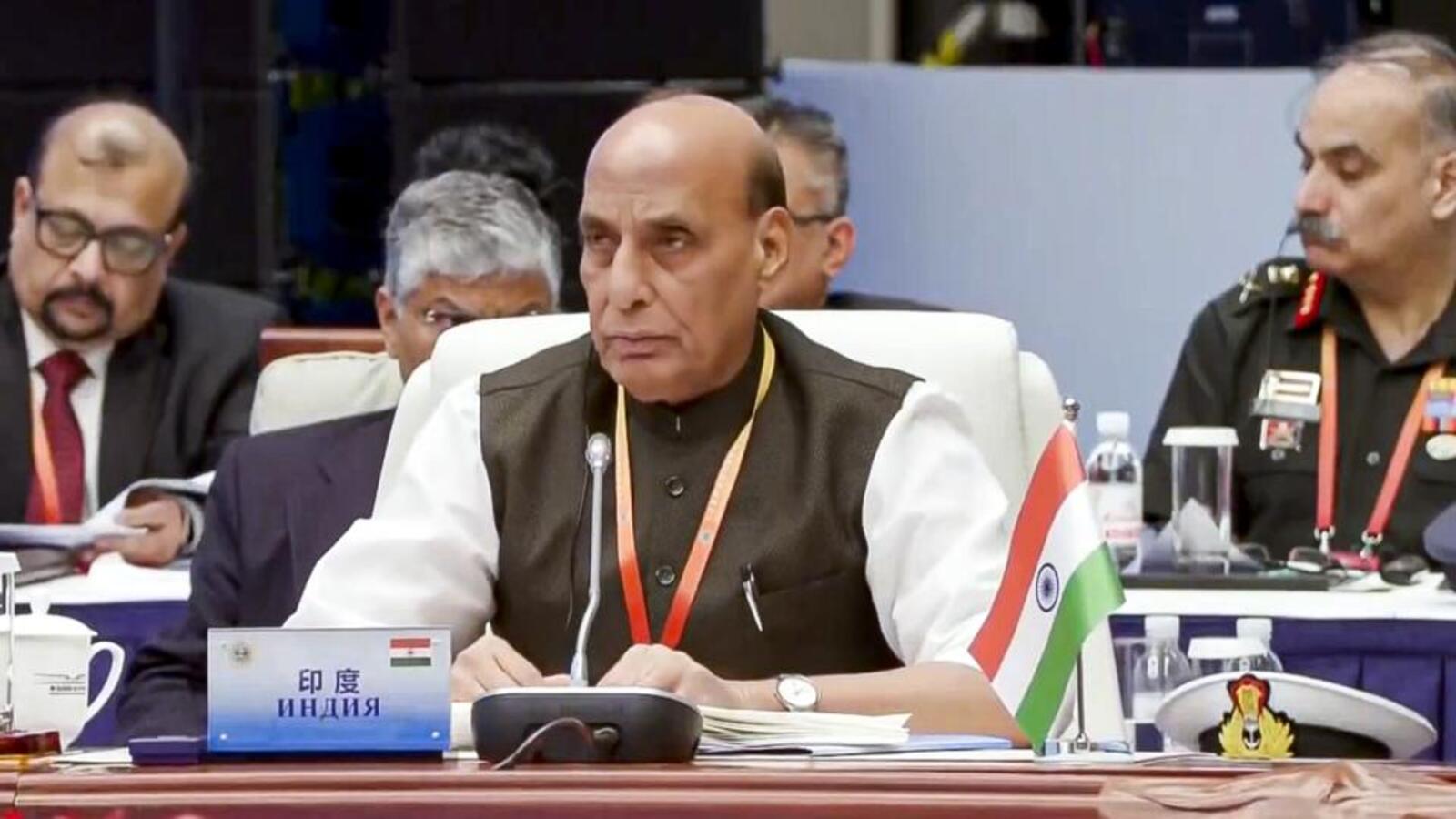
WASHINGTON -India Defence Minister Rajnath Singh on Thursday said that the Shanghai Cooperation Organization should not hesitate to criticize nations engaged in cross-border terrorism and harboring terrorists.
Singh said “Peace and prosperity cannot co-exist with terrorism and proliferation of Weapons of Mass Destruction in the hands of non-state actors and terror groups,” in his address at the SCO Defence Ministers’ Meeting at Qingdao, China.
He outlined India’s stance taken against terrorism during Operation Sindoor, Singh said that dealing with the challenges requires decisive action. “It is imperative that those who sponsor, nurture and utilize terrorism for their narrow and selfish ends must bear the consequences. Some countries use cross-border terrorism as an instrument of policy and provide shelter to terrorists. There should be no place for such double standards. SCO should not hesitate to criticise such nations,” he added.
Mr. Singh defended India’s military actions during Operation Sindoor, said that it was in response to the heinous terror attack in Pahalgam, Jammu and Kashmir, and the country exercised its right to defend against terrorism and pre-empt as well as deter further cross-border attacks.
“During the Pahalgam terror attack, victims were shot after they were profiled on religious identity. The Resistance Front, a proxy of UN-designated terror group Lashkar-e-Taiba (LeT) claimed responsibility for the attack. The pattern of the Pahalgam attack matches with LeT’s previous terror attacks in India. India’s zero tolerance for terrorism was demonstrated through its actions. It includes our right to defend ourselves against terrorism. We have shown that epicentres of terrorism are no longer safe and we will not hesitate to target them,” he said.
He stated that there was a need to hold the perpetrators, organizers, financiers and sponsors of reprehensible acts of terrorism, including cross-border terrorism, accountable and bring them to justice.
Singh termed any and every act of terrorism criminal and unjustifiable regardless of their motivation, whenever, wherever and committed by whom-so-ever. SCO members must condemn this evil unequivocally, he said, reaffirming India’s resolve to fight terrorism in all its forms and manifestations.
He called upon the member countries to unite in eliminating the menace for collective safety and security, Singh said that the biggest challenges faced by the region are related to peace, security and trust-deficit, with increasing radicalization, extremism and terrorism being the root cause of these problems.
Defence minister called for proactive steps to prevent the spread of radicalization among the youth, acknowledging the significant role of the Regional Anti-Terrorist Structure mechanism in tackling the challenge. “The joint statement of the Council of SCO Heads of State on ‘Countering Radicalization leading to Terrorism, Separatism and Extremism’ issued during India’s Chairmanship symbolizes our shared commitment,” he stated.
He underscored the importance of countering the technology used by terrorists, including drones for cross-border smuggling of weapons and drugs, pointing out that traditional borders are no longer the sole barriers against threats in this interconnected world.
Singh stressed that the world faces an intricate web of challenges that range from transnational terrorism and cyberattacks to hybrid warfare. These threats, he said, do not respect national boundaries and demand a unified response rooted in transparency, mutual trust, and collaboration.
He stated that globalization has been losing momentum, and the weakening of multilateral systems has made it harder to address urgent challenges, from maintaining peace and security to rebuilding economies after the pandemic, the defence minister said that competition between major powers is intensifying, with trade and technology being increasingly used as tools in geopolitical rivalries.
“India believes that reformed multilateralism can help build cooperation to prevent conflict between countries by creating mechanisms for dialogue and collaboration,” he said.
He also spoke about India’s commitment to increasing its connectivity with Central Asia.
“Better connectivity not only enhances mutual trade but also fosters mutual trust. However, in these efforts, it is essential to uphold the basic principles of the SCO charter, particularly respecting the sovereignty and territorial integrity of member states,” he said.
He added that India has been consistent and steadfast in its policy in support of peace, security and stability in Afghanistan. “As Afghanistan’s largest regional development partner, India continues to implement capacity-building initiatives for the Afghan people,” he said.
