

GG News Bureau
Tehran/Jerusalem, 22nd June: Iran has launched its most powerful missile, the Khorramshahr-4, in a major retaliatory strike against Israel, hours after the United States bombed three of Iran’s key nuclear facilities.
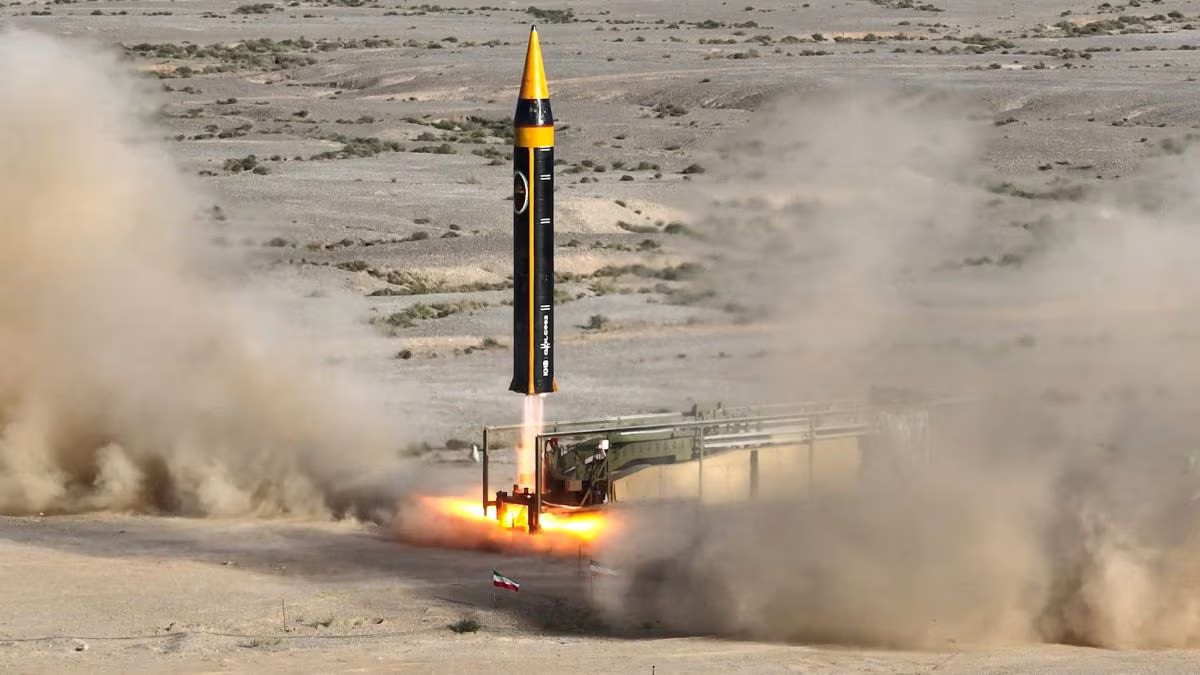
According to Iranian state media, the Khorramshahr-4 — also known as Kheibar — was used in the volley of at least 40 missiles fired early Sunday by the Islamic Revolutionary Guard Corps (IRGC). The missile, which has a reported range of 2,000 km and the capacity to carry a 1,500-kg payload or multiple warheads, is among Iran’s most advanced in its arsenal.
The strike followed U.S. air raids on Iran’s nuclear sites in Fordow, Natanz, and Isfahan. Iran responded with force, striking areas across central Israel, including Tel Aviv.
Local reports and eyewitness accounts describe severe damage in northern Tel Aviv, where a shopping centre, a bank, and a salon were hit. Streets were littered with broken glass and debris. At least 11 injuries have been reported so far. Rescue workers and security forces were deployed to the affected areas, blocking roads and clearing wreckage.
One resident recounted how his first-floor apartment was destroyed in a strike: “Luckily, I had gone to my mother’s house. Otherwise, I wouldn’t be here talking.”
The Khorramshahr-4 missile is named after the Iranian city that saw intense fighting during the 1980s Iran-Iraq war. Its alternate name, Kheibar, refers to a historical fortress captured in the 7th century, a symbolic gesture that underscores the missile’s intended message.
Tensions in the region have escalated rapidly following the U.S. strikes on June 22. As Iran vows further retaliation and the U.S.-Israel axis signals readiness for a prolonged campaign, regional stability hangs in the balance.
