
A Declaration That Sounds Strong—but Rings Hollow: INDIA Bloc’s Crisis of Cohesion

Paromita Das
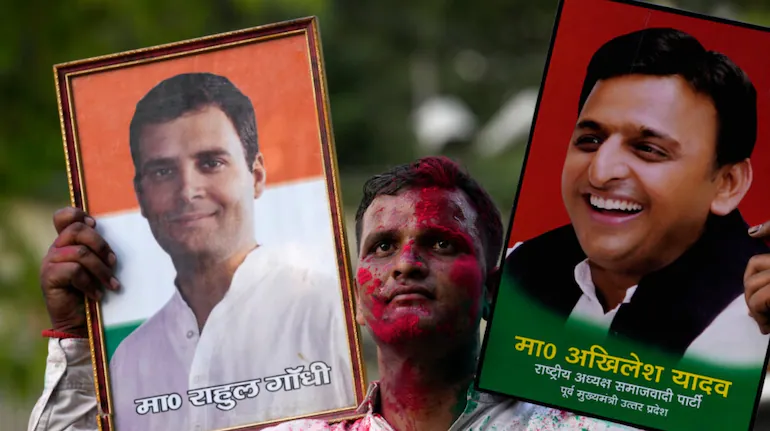
New Delhi, 20th June: When Samajwadi Party (SP) president Akhilesh Yadav declared that all parties within the INDIA bloc would contest the 2027 Uttar Pradesh Assembly elections together, it sounded like a moment of renewed strength for the opposition. Uttar Pradesh is not just another state—it’s the largest and most politically influential in Bharat. A joint fight there could, in theory, seriously challenge the BJP’s grip on power. Yet the alliance’s recent track record casts doubt on whether this promise is anything more than political theatre.
Since its formation in 2023, the INDIA bloc—comprising over two dozen parties including the Congress, AAP, TMC, DMK, and Left outfits—has failed to demonstrate operational unity. While public statements exude coordination, the alliance’s internal mechanisms are anything but harmonious.
The Illusion of Coordination
The most telling evidence of this fractured alliance came during the 2024 Lok Sabha elections. Though the Congress and the SP did eventually agree on a seat-sharing formula in Uttar Pradesh, the negotiations were messy and public. At one-point, senior Congress leaders hinted at contesting alone, frustrated by the SP’s perceived rigidity. Meanwhile, SP insiders privately criticized the Congress’s lack of grassroots presence in the state, arguing that it brought little to the table in terms of winnable seats.
This wasn’t a one-off episode. In Punjab and Delhi, the Aam Aadmi Party and Congress failed to strike any electoral understanding, contesting against each other and handing easy wins to the BJP. In West Bengal, Mamata Banerjee’s TMC distanced itself from the bloc altogether, asserting its independence and implicitly rejecting the Congress’s claim to leadership within the alliance.
These examples point to a deeper malaise within the INDIA bloc: a lack of mutual trust, strategic coherence, and respect for shared leadership. Every party seems to be guarding its turf more than advancing a common agenda.
Public Confidence Is Eroding
The INDIA bloc has long claimed to represent democratic plurality in contrast to what it calls the BJP’s centralized authoritarianism. But this messaging rings hollow when the alliance cannot even agree on a common candidate list, let alone a coherent campaign strategy.
Voters are not blind to these inconsistencies. They see the bloc’s public bickering, confusing alliances, and absence of a unifying face. Leaders like Mamata Banerjee and Nitish Kumar have skipped key meetings. Congress remains torn between asserting its dominance and accommodating regional powerhouses. In the absence of a central decision-making body or a binding agenda, the bloc looks more like a temporary alignment of convenience than a sustainable political force.
Akhilesh’s Optimism vs. Ground Reality
In such a chaotic backdrop, Akhilesh Yadav’s confident assertion of a joint campaign in 2027 can seem disconnected from reality. While his intent may be genuine—stemming from the realization that fragmented opposition only benefits the BJP—the machinery to implement such unity is glaringly absent.
His statement might help project a façade of stability, possibly aimed at energizing the party base and attracting undecided voters. But unless that optimism is backed by concrete groundwork, it risks becoming just another slogan.
Can the INDIA Bloc Truly Come Together?
From an analytical standpoint, the INDIA bloc’s concept still holds potential. An alliance that combines Congress’s national presence with the regional strength of parties like SP, TMC, and DMK could theoretically challenge BJP dominance. But politics is not built on potential—it thrives on execution.
For the INDIA bloc to stand a real chance in 2027, particularly in Uttar Pradesh, it must evolve from being an umbrella term for disparate parties into a disciplined, strategic coalition. That means ironing out egos, establishing a permanent coordination committee, selecting a face for leadership, and agreeing on a common minimum programme.
If these systemic changes are not implemented soon, the alliance may again enter an election cycle torn by internal contradictions, which the BJP is well-equipped to exploit.
Words Are Not Enough—Action Must Follow
Akhilesh Yadav’s declaration is a timely reminder of the importance of unity in Bharatiya politics, especially in states as crucial as Uttar Pradesh. But unity can’t be proclaimed into existence—it must be built through hard negotiations, mutual respect, and shared sacrifice. So far, the INDIA bloc has failed to live up to those ideals.
The road to 2027 is long, and if opposition parties are serious about presenting a viable alternative to the BJP, they must start laying the groundwork now. Public trust, once eroded, is hard to regain. The bloc must prove through action—not rhetoric—that it can function as a unified, disciplined front.
Until then, Akhilesh’s promise will remain what it currently appears to be: more aspirational than achievable.
