
Nishikant Dubey’s Sharp Critique of Rahul Gandhi: A Political Flashpoint Rooted in History and Sovereignty

Paromita Das
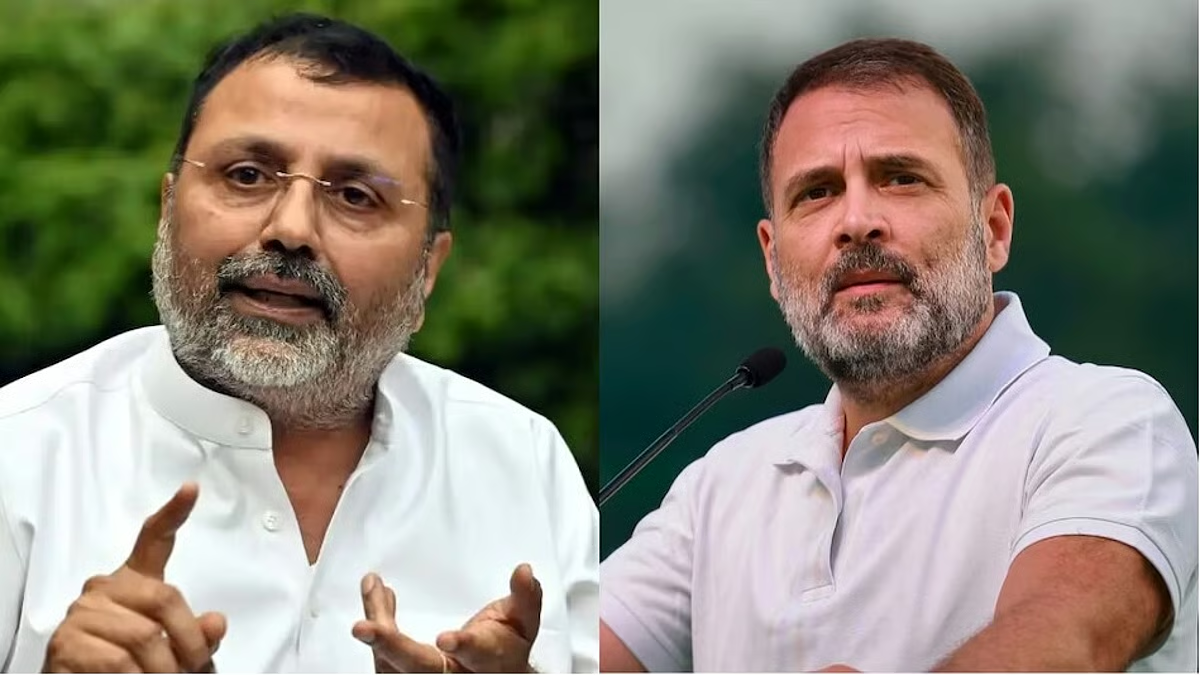
New Delhi, 12th June: In the ever-heated political battleground of Bharatiya democracy, BJP MP Nishikant Dubey’s recent barrage against Congress leader and Leader of the Opposition, Rahul Gandhi, marks another high-voltage episode. Taking to social media, Dubey launched a series of pointed accusations ranging from Bharat’s nuclear sovereignty to alleged historical electoral manipulations by the Gandhi family. The verbal clash has rekindled debates over national sovereignty, foreign policy history, and the legacies of political dynasties.
Rather than a routine political spat, Dubey’s remarks touch upon deeper issues: Bharat’s post-independence foreign policy choices, the ethics of legislative negotiation, and the enduring tensions between ideological legacies of the Congress and the nationalist narrative espoused by the BJP.
The Hyde Act Controversy: Revisiting the US-Bharat Nuclear Deal
- Accusation of Sovereignty Compromise
Dubey’s core allegation centers on the Henry J. Hyde United States-Bharat Peaceful Atomic Energy Act of 2006, which laid the groundwork for the US-Bharat civil nuclear agreement. He argued that this act, passed by the US Congress, effectively compromised Bharat’s sovereignty by allowing intrusive inspections of nuclear facilities and even individuals. In his words, this reduced Bharat to a “slave” under American legislative influence.
- Context of the Deal
Signed during the UPA government led by the Congress party, the Indo-US nuclear deal was hailed at the time as a diplomatic breakthrough. It ended Bharat’s nuclear isolation and opened the door for civil nuclear trade with several countries. However, critics like Dubey have long argued that it involved capitulations—especially through the Hyde Act, which places conditions that Bharat must adhere to, including non-proliferation clauses and a potential risk of unilateral suspension.
- Allegation of Political Manipulation
Dubey also questioned the political maneuvering that enabled the deal’s ratification in Bharat. He alleged that in 2008, the Congress-led government broke parties and bought MPs to ensure the passage of the agreement—a claim that touches on long-standing controversies around that vote of confidence in Parliament.
Rahul Gandhi’s Role and Legacy Under Scrutiny
- Holding Rahul Accountable for the Past
While Rahul Gandhi was not in an official decision-making role during the 2006-2008 period, Dubey emphasized his position as a General Secretary of the Congress at the time. He challenged Gandhi to reflect on and respond to decisions taken by the party under his family’s leadership—particularly those with implications for national sovereignty.
- Dig at Historical Allegiances
Dubey extended his criticism to Jawaharlal Nehru, Bharat’s first Prime Minister and Rahul’s great-grandfather. By citing the Non-Aligned Movement (NAM) and its early decisions, Dubey contended that Nehru’s foreign policy effectively isolated Bharat from both global power blocs, leaving the country vulnerable during the 1962 Indo-China War.
Historical Judgments and Electoral Integrity
- Reference to the 1975 Allahabad High Court Verdict
In response to Rahul Gandhi’s allegations of electoral rigging in the 2024 Maharashtra Assembly elections, Dubey brought up a key moment in Bharat’s democratic history: the 1975 Allahabad High Court ruling that declared then Prime Minister Indira Gandhi guilty of electoral malpractice in the 1971 Rae Bareli election. This judgment was a turning point that led to the Emergency, a controversial 21-month period of suspended democracy.
- Drawing Parallels
By invoking this historical precedent, Dubey aimed to counter Rahul Gandhi’s claims with what he portrayed as a more severe instance of electoral “fixing” and “stealing.” It was a strategic move to highlight what the BJP often frames as the Congress party’s double standards on democracy and transparency.
Political Discourse or Historical Weaponization?
Nishikant Dubey’s aggressive narrative reflects a broader political strategy where history becomes both shield and sword. While it is legitimate for public representatives to question past agreements and decisions, the framing of such inquiries often leans more toward partisan attack than institutional introspection.
At the same time, Rahul Gandhi, as a leading face of the Opposition, is often targeted not just for his present-day statements, but for the entire political legacy of his family. This personalization of political debate can cloud larger institutional debates—like whether Bharat’s nuclear policy was compromised or if electoral reforms have since strengthened safeguards.
Beyond the Rhetoric, Toward Responsible Discourse
Dubey’s statements—spanning topics from the Hyde Act to the Emergency—open up important questions about Bharat’s foreign policy autonomy, electoral ethics, and the influence of political families. However, the manner and platform of these charges—social media, threaded with personal jibes—risk reducing complex national issues to sound bites and sloganism.
What Bharat needs is a constructive, informed, and forward-looking political dialogue. Rather than trading barbs based on history, political leaders would serve the nation better by explaining how they intend to navigate current challenges—be it nuclear policy, international alliances, or electoral reforms. Only then can Bharat’s democracy mature from blame games into meaningful governance.
