

GG News Bureau
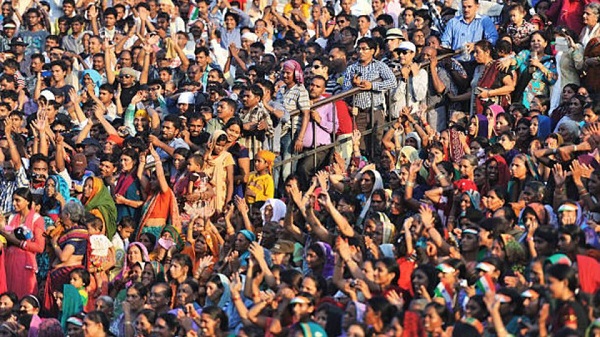
New Delhi, 10th June: India’s population is estimated to hit 1.46 billion in 2025, solidifying its position as the world’s most populous nation. However, a new UNFPA 2025 State of World Population (SOWP) Report, “The Real Fertility Crisis,” reveals a significant demographic shift: India’s total fertility rate has now dropped below the replacement level.
The report emphasizes that the true focus should be on unmet reproductive goals, not just falling fertility rates. It argues that the real crisis is that millions of people cannot achieve their desired family sizes, regardless of concerns about under- or overpopulation. The solution, it suggests, lies in greater reproductive agency—giving individuals the freedom and information to make their own choices about sex, contraception, and starting a family.
The SOWP Report highlights key changes in India’s population, fertility, and life expectancy, signaling a major demographic transition. Notably, India’s total fertility rate has fallen to 1.9 births per woman, below the replacement level of 2.1. This means Indian women are, on average, having fewer children than needed to maintain the population size from one generation to the next, without considering migration.
India’s Young and Working-Age Population
Despite the slowing birth rate, India still has a substantial youth population. The report shows that 24% of the population is aged 0-14, 17% is 10-19, and 26% is 10-24.
A significant 68% of India’s population is of working age (15-64). This presents a potential “demographic dividend,” but the report warns this benefit can only be fully realized if there are enough jobs and supportive policies.
The elderly population (65 and older) currently stands at 7%, a figure expected to rise in the coming decades as life expectancy improves. For 2025, life expectancy at birth is projected to be 71 years for men and 74 years for women.
According to UN estimates, India’s current population is 1,463.9 million. The report forecasts this number will grow to approximately 1.7 billion before it begins to decline, roughly 40 years from now.
From Six Children to Two: A Story of Choice
The report emphasizes that behind these numbers are the individual stories of millions of couples making family decisions. It also reflects the experiences of women who historically had very limited choices regarding pregnancy. In 1960, when India’s population was around 436 million, the average woman had nearly six children. The report points out that back then, women had less control over their bodies and lives, with fewer than 1 in 4 using contraception and less than half attending primary school (World Bank Data, 2020).
However, in recent decades, India has seen significant improvements in education, better access to reproductive healthcare, and greater empowerment for women in decisions affecting their lives. As a result, the average Indian woman now has about two children. While women in India and globally have more rights and choices today, the report stresses that there’s still progress needed for them to have the exact number of children they desire, if any, and when they desire them.
The UN report places India among middle-income countries undergoing rapid demographic change, with its population doubling time now estimated at 79 years.
“India has made significant progress in lowering fertility rates — from nearly five children per woman in 1970 to about two today, thanks to improved education and access to reproductive healthcare,” said Andrea M Wojnar, UNFPA India Representative. “This has led to major reductions in maternal mortality, meaning millions more mothers are alive today, raising children and building communities. Yet, deep inequalities persist across states, castes, and income groups.”
Wojnar concluded, “The real demographic dividend comes when everyone has the freedom and means to make informed reproductive choices. India has a unique opportunity to show how reproductive rights and economic prosperity can advance together.”
