

By Anjali Sharma
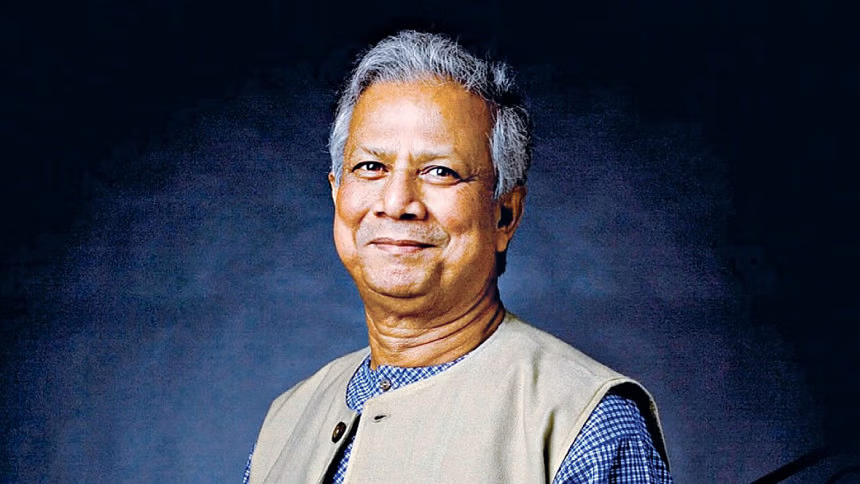
WASHINGTON – Bangladesh’s Chief Adviser, Professor Muhammad Yunus on Saturday announced his 11th foreign visit in past 11 months is scheduled visit UK from June 9-13, as per media reports.
The reliable sources said that Yunus will hold elections in April 2026 will hold a political dialogue with Bangladesh Nationalist Party’s Acting Chairman Tarique Rahman.
Tarique Rahman in a rally had stated that historically, caretaker governments in Bangladesh have shown that national elections can be organized and executed within three months. The precedent is clear: it can be done.
“And yet, ten months into its tenure, the interim administration has still not announced an election date. The people of Bangladesh deserve better. We seek a nation free from authoritarianism, led by a government elected through a fair vote, and accountable to its citizens,” he had said.
BNP has stated that it wants the national elections to be held by December this year as it perceives a “clear victory” minus the Awami League.
Tarique Rahman are strongly opposed to Yunus’s incrementalism and his advisors, mostly from the July uprising of 2024. At home, there is hardly any political or economic value for Yunus.
The BNP wants an “honest assessment of what has been actually accomplished” in these months and not what was “spin-doctored” as Yunus is in the habit of doing.
Bangladesh military wanted the national election to be held by December 2025. Gen Waker-uz-Zaman, the Chief of Army Staff, had drawn the red lines for the Yunus administration.
Bangladeshis in Britain are mainly concentrated in Greater London boroughs such as Tower Hamlets, Newham, and Camden.
Outside London, the British Bangladeshi community is heavily concentrated in major cities such as Birmingham, Manchester and other urban centres across the UK.
Islam, as a religion, plays a binding factor among young British Bangladeshis, who have questioned the secular nationalism of their parents and grandparents. Many British Bangladeshi citizens are active in British politics.
The Conservative Friends of Bangladesh at Westminster on April 28 discussed Bangladesh’s fragile transition, law and order, safety of religious minorities, promises of reform and democracy and an inclusive election under the Interim Government.
Lord Jonathan P. Marland, Chairman of the Commonwealth Enterprise & Investment Council, chaired the meeting. Richard Fuller, the MP from North Bedfordshire & Shadow Chief Secretary, Gareth Bacon, the MP from Orpington & Shadow Transport Secretary, Bob Blackman, the MP from Harrow East, Chairman of the 1922 Committee & Chair of the Backbench Business Committee, participated in the meeting and voiced their concern on the prevailing situation in Bangladesh.
The participants expressed grave concern over the plight of minorities due to the disturbed political situation and also dwelt on fragile economic conditions.
They pledged help and support from Conservative Party leaders and members to hold a free, fair and inclusive election, revive the economy and ensure adequate safeguards for minorities.
British politician and prominent jurist Lord Alex Carlile of Berriew chaired the seminar on ‘Democracy, Human Rights, Good Governance, Rule of Law and the role of Political Parties in Bangladesh’s current political landscape’, held at the House of Commons.
The event was organized by Blackman, who is also the President of the Parliamentary Group ‘Conservative Friends of Bangladesh’, and he called for “sincere efforts” to make the upcoming elections in Bangladesh fair, impartial and inclusive.
King’s Counsel John Cammegh in his message advised the Bangladeshi interim government to prioritize political, social, and economic democratization over establishing an International Criminal Tribunal against the previous government.
He warned that such tribunals often serve as tools for political retribution, fostering division and anxiety. Asserting that it will only help the income of legal advisors, he advocated for a Truth and Reconciliation Commission to promote unity and healing in Bangladesh.
Yunus wants to gain international legitimacy, economic and political support, diplomatic recognition, as well as influence from Western perspectives.
The Awami League never missed an opportunity to attack Yunus, and no doubt, Yunus is paying back the same with dividends by banning the Awami League.
In the complex, personal jealousy of Yunus, there is a precipitous decline of democracy and human rights in Bangladesh, with a growing Western/US trend of turning a blind eye to Yunus’s adverse activities.
Yunus will receive the “King Charles III Harmony Award 2025”. A bilateral meeting with UK PM Keir Starmer is also scheduled at 10 Downing Street on June 11.
Major issues that are likely to be discussed are prevention & repatriation of illicit capital with Bangladesh expected to request British government’s support in repatriating funds allegedly laundered during AL’s tenure, seek the UK’s backing for the reforms and election preparations by the interim government in Bangladesh, support for the July-August mass movement, and investment and export trade.
The British High Commissioner to Bangladesh, Sarah Cooke, met Yunus on Wednesday at the State Guest House in Dhaka.
Their discussions encompassed a range of mutual interests including trade and investment, aviation cooperation, migration, and the interim government’s efforts in asset recovery (the interim government says the previous regime enabled the laundering of an estimated $16 billion annually.
Yunus expressed interest in receiving technical support from the UK, including training by British researchers, to boost Bangladesh’s ocean research efforts.
The meeting was attended by Lutfey Siddiqi, the Chief Adviser’s envoy for international affairs, Lamiya Morshed, the Sustainable Development Goals Coordinator, and James Goldman, Deputy High Commissioner of Britain, media reported.
