
BIG UGLY BREAK-UP: Who Will Get a Black Eye in This American Reality Show?

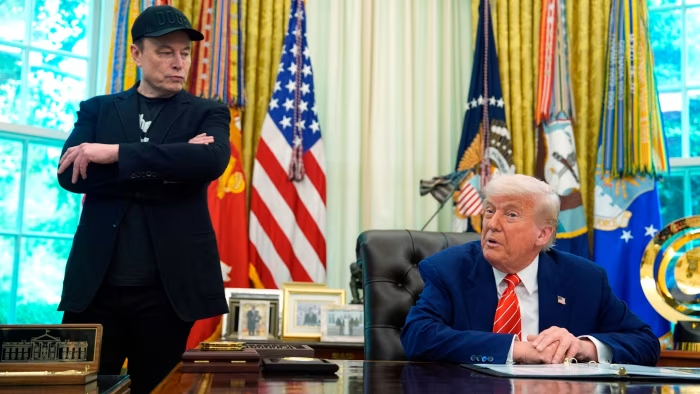
June 6, 2025. Washington, D.C. – The alliance between tech titan Elon Musk and President Donald Trump, once a powerhouse of wealth and political bravado, has exploded into a public feud that’s gripping the nation like a prime-time reality show. On June 5, 2025, Tesla’s stock crashed 14.3%, erasing $150–152.5 billion in market value and costing Musk $8.73–17.2 billion personally. Trump’s threats to cancel billions in SpaceX contracts have upped the ante, turning their clash over the “Big Beautiful Bill” into a high-stakes drama. From Musk’s $288 million campaign support to a bitter war of words on X and Truth Social, this break-up is a saga of betrayal, egos, and economic fallout. Who will emerge with the darker black eye, and can they find a way out?
Roots in Blue: Democratic Fuel for Musk’s Empire
Musk’s Tesla and SpaceX owe much of their success to Democratic policies. In 2010, President Obama’s administration granted Tesla a $465 million Advanced Technology Vehicles Manufacturing loan, a lifeline for its Model S and Fremont factory. The Biden administration’s 2022 Inflation Reduction Act revived the $7,500 EV tax credit, driving Tesla’s 1.8 million global vehicle deliveries in 2023 and $1.47 billion in California ZEV credit sales. SpaceX flourished with NASA contracts, from the $2.6 billion Commercial Crew Program (2014, Obama) to $1.4 billion for ISS missions (Biden). These policies, rooted in Democratic support for clean energy and space exploration, built Musk’s $400 billion net worth by December 2024. Yet, Musk stunned observers by betting on Trump in 2024.
A Surprising Alliance: Musk’s Pivot to Trump
Musk’s shift to Trump was driven by ideology and frustration. His libertarian streak—championing deregulation and free markets—aligned with Trump’s promise to gut bureaucracy. Biden’s snubs, like excluding Tesla from a 2021 EV summit and praising unionized automakers, stung Musk, who faced NHTSA probes into Tesla’s Full Self-Driving and NLRB rulings against his labor practices. Trump offered a platform: co-leading the Department of Government Efficiency (DOGE), a task force to slash federal spending by 75%. Musk’s $288 million in campaign funds and X’s 200 million followers amplified Trump’s 2024 victory, with Musk later claiming, “Without me, Trump would have lost.”
DOGE Days: Musk’s Moment in the Spotlight
Launched in January 2025, DOGE gave Musk a stage to push for a leaner government. Tesla capitalized on the buzz, with Musk showcasing vehicles on the White House lawn, driving showroom traffic. But his radical proposals, like abolishing agencies, and a controversial Nazi-associated salute at Trump’s inauguration triggered backlash. Consumer boycotts cut Tesla’s Q1 2025 sales by 13–15%. Musk’s influence peaked, but his DOGE tenure ended on May 30, 2025, due to a 130-day term limit—not a “firing,” as Trump later claimed. Sources say Musk felt sidelined, especially after Trump nixed Jared Isaacman’s NASA nomination, setting the stage for betrayal.
A Policy Betrayal: The End of EV Subsidies
The “Big Beautiful Bill,” passed by the House in June 2025, became the feud’s flashpoint. The bill, extending Trump’s 2017 tax cuts, adds $2.4 trillion to the national debt and axes the $7,500 EV tax credit. J.P. Morgan estimates this will cost Tesla $1.2 billion in annual profits and $2 billion in ZEV credits, threatening its 50% U.S. EV market share. Trump’s tariffs, raising costs for Tesla’s China-reliant supply chain, further clashed with Musk’s “zero-tariff” stance. The bill’s “pork-filled” spending defied Musk’s DOGE vision, prompting him to call it a “disgusting abomination” and fueling his sense of betrayal after his $288 million campaign investment.
Reality Show Rumble: The Feud Goes Viral
On June 5, 2025, the feud erupted on X, with Musk slamming the bill and making unverified claims about Trump in Epstein files, even endorsing a call to impeach him and install J.D. Vance. Trump retaliated on Truth Social, accusing Musk of “Trump derangement syndrome” and threatening to cancel SpaceX contracts and Tesla subsidies. The public clash, amplified by both men’s social media megaphones, tanked Tesla’s stock, costing Musk billions and captivating the nation like a reality TV cliffhanger.
Public Fireworks Over Private Talks
Why did Musk go public instead of negotiating quietly? The bill’s swift House passage left little time for diplomacy, and his post-DOGE exit slashed his influence. Musk’s confrontational style—honed in spats with regulators—made X his weapon to rally Senate opposition, where the bill faces hurdles. His Epstein claim and impeachment call, however, were high-risk missteps, alienating Trump’s base and progressives while worsening Tesla’s $150 billion market cap loss and risking SpaceX’s billions in contracts.
Tallying the Bruises: Who’s Hurt More?
Musk faces the darker black eye. Tesla’s $150–152.5 billion loss and $8.73–17.2 billion personal hit, plus threats to SpaceX’s NASA/DoD contracts, strike at his empire’s core. His rhetoric isolates him politically, with Tesla’s sales (down 13–15% in Q1) at risk from further boycotts. Trump, bruised by Senate pushback and reputational dings, is cushioned by Republican congressional control and a loyal base. His power to target Musk’s subsidies and regulations gives him the edge, making Musk the bigger loser.
Third-Party Dream or Distraction?
Musk’s June 5 X post, proposing a party for “the 80% in the middle,” reflects his frustration with Trump and both parties. Constitutionally viable, it faces steep barriers—winner-takes-all voting, ballot access laws, and entrenched party dominance, as seen in Ross Perot’s 1992 failure (19.9% vote, zero electoral votes). Musk’s wealth and X platform could fuel it, but his polarizing image risks undermining a centrist appeal, diverting focus from Tesla and SpaceX’s woes.
Finding a Way Forward
De-escalation is critical but challenging given both men’s egos. Musk could retract inflammatory claims and lobby Senate Republicans quietly, leveraging J.D. Vance’s tech-friendly stance to restore EV subsidies or protect SpaceX contracts. Trump could offer concessions, like partial subsidy reinstatement or tariff exemptions, to stabilize markets and preserve his space agenda, reliant on SpaceX’s Artemis and ISS missions. A private summit, mediated by Vance, could mend ties, but without compromise, Musk’s third-party gambit and Trump’s bill face uncertain fates, prolonging this drama.
This “Big Ugly Break-Up” has all the trappings of reality TV—betrayal, insults, and billion-dollar stakes. Musk’s $288 million investment in Trump, followed by policy blows to Tesla, has left him bloodied, with Trump holding the political upper hand. As America watches, the question looms: will this feud reshape the political landscape, or leave Musk’s empire with the deepest scars?
