

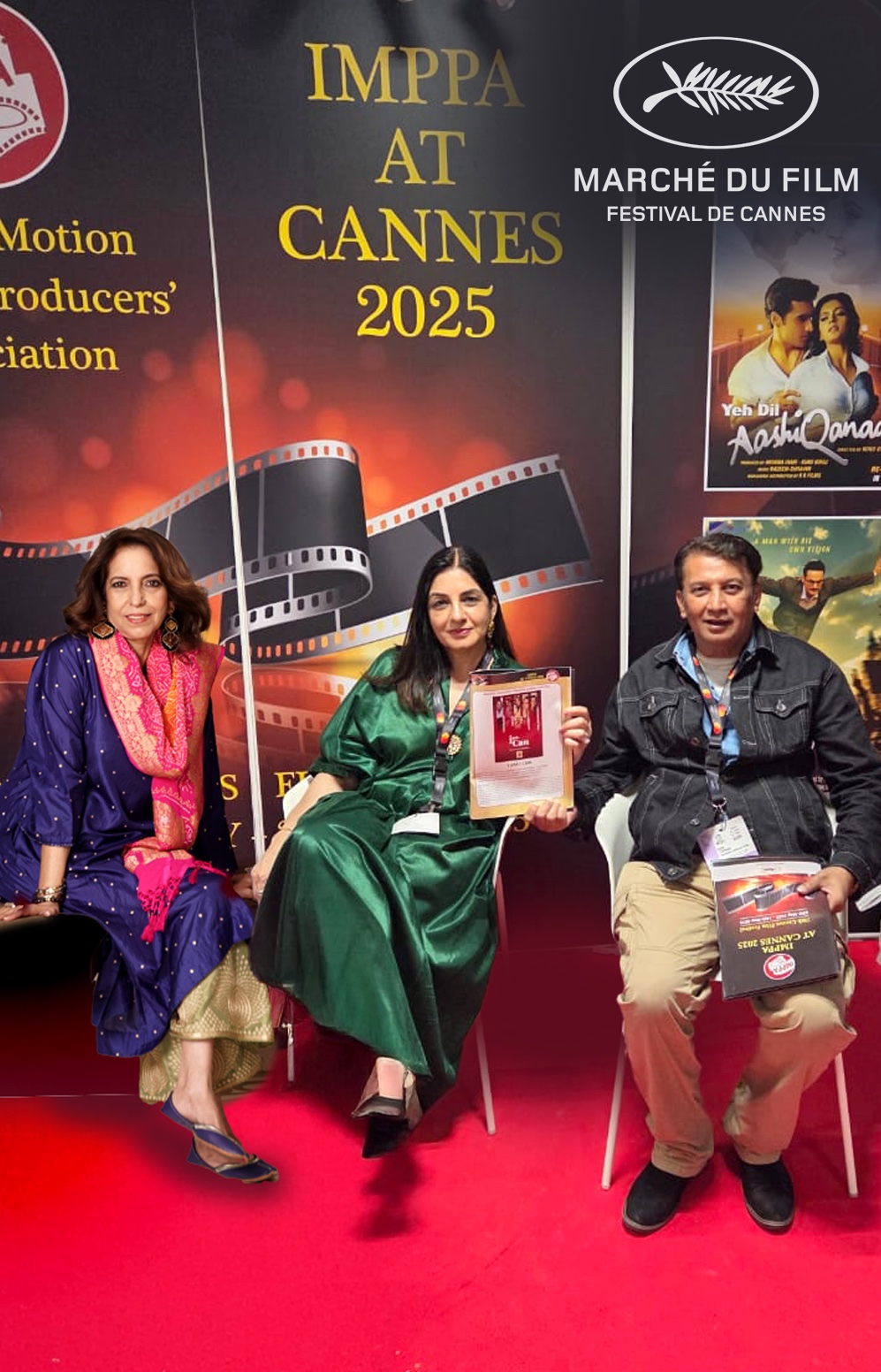
In the glittering constellation of stories that grace the Cannes Film Festival, few shine with the quiet, resolute brilliance of I Am, I Can, a documentary by director Ajay Chitnis that chronicles the extraordinary life of Prof. Dr. Minu Bakshi. Screened at Palais B on May 14 during the Marché du Film, under the banner of the Indian Motion Picture Producers’ Association (IMPPA), this film is more than a biography—it is a testament to the power of a woman who has woven a tapestry of art, intellect, and compassion, defying boundaries and inspiring countless others along the way.
Minu Bakshi is no stranger to those who have crossed her path. To me, she was a beacon during my early days at Jawaharlal Nehru University (JNU), where, as a wide-eyed 19-year-old undergraduate, I found myself overwhelmed by the intellectual rigor of my peers—mostly PhD students a decade my senior. My enthusiasm for knowledge led me down rabbit holes of Marxist philosophy, Western history, Japanese literature, and Sanskrit theater, but my academic focus faltered, and my CGPA suffered. It was Minu Bakshi, my Spanish professor, who gently but firmly guided me back to the path. With her wisdom and warmth, she reminded me that passion, when channeled with discipline, could transform dreams into reality. Her influence was not just academic; it was profoundly human, a reminder of her boundless capacity to uplift those around her.
This same spirit animates I Am, I Can, a film that captures the essence of a woman who has lived many lives within one. Minu Bakshi is a retired Assistant Professor of Spanish at JNU, where she taught for nearly four decades and served as an accredited interpreter for the Indian government, working alongside luminaries like the President and Prime Minister. Her academic accolades include the prestigious “Order of Isabella la Catolica” from the Spanish government, a rare honor for a foreigner, recognizing her role in fostering Spanish culture in India. Yet, her story transcends the classroom. She is a Hindustani classical singer, a celebrated Urdu poet, a preserver of Punjabi folk music, and a philanthropist whose heart beats for the underprivileged.
The documentary, directed with understated grace by Ajay Chitnis, traces Minu’s journey from her early days in a traditional Punjabi family in Delhi to her global impact as an artist and advocate. Inspired by a concert by the legendary Begum Akhtar, she embraced Urdu poetry and ghazal with a fervor that would define her creative life. Her poetry collections—Tishnagi – The Thirst, Mauj-e-Saraab – The Waves of Illusion, Justaju, Uffuq ke Paar, and Abr-e-Karam—pulse with a feminine sensibility, romanticism, and mystic depth, earning praise from icons like Shabana Azmi, Sharmila Tagore, Muzaffar Ali, and Javed Akhtar. Her verses, recited at literary festivals from Delhi to Lahore, London to the USA, are a clarion call for self-expression, resonating with women who dare to dream.
As a musician, Minu has breathed new life into Punjabi folk traditions while embracing modern collaborations. Her albums, from the soulful ghazals of Phir Se to the vibrant Lao Mehndiyan I & II and the monumental 8-CD Band Baja Punjab, have cemented her as a cultural custodian. Her collaboration with Mika Singh on DJ Waleya—which garnered over five million YouTube views in just 30 days—shows her ability to bridge tradition and modernity with ease. Her performances at venues like the Delhi International Arts Festival and global charity events radiate her commitment to art as a force for connection and healing.
But Minu Bakshi’s legacy extends beyond her creative output. As Chairperson of Savera, an NGO dedicated to empowering underprivileged women and children, she has transformed countless lives. Her donation of the MB Language Lab to JNU’s School of Language, Literature and Culture Studies is just one example of her commitment to education. Her efforts have earned her accolades like the “Fakhr-e-Hind” for Urdu literature, the “Achiever’s Award 2014” presented by former Prime Minister Dr. Manmohan Singh, and the “Ambassador of Hope Award” for her poetic reflections during the COVID-19 pandemic. Each honor reflects her unwavering dedication to humanity.
I Am, I Can does not merely recount these achievements; it invites us into Minu’s inner world, where passion meets perseverance.
Ajay Chitnis, with his extensive experience in documentary filmmaking, chooses a restrained yet powerful approach, letting Minu’s words, music, and actions speak for themselves. The film is a delicate balance of observation and inspiration, avoiding heavy-handed narration to focus on the authenticity of her journey. It acknowledges the quiet strength of her husband, Kanwaljit Singh Bakshi, whose support has been a cornerstone of her multifaceted life.
At Cannes, I Am, I Can stood as a beacon of Indian storytelling, its universal themes of resilience and self-definition resonating with an international audience. In an era where women’s empowerment is a global conversation, Minu’s story—rooted in Indian culture yet boundless in its appeal—offers a fresh perspective. It is not about grand gestures but about the everyday courage to live authentically, to create without fear, and to give back selflessly. The film’s presence at the Marché du Film, facilitated by IMPPA, underscores the growing appetite for narratives that celebrate cultural heritage while speaking to universal human truths.
For those who know Minu Bakshi, I Am, I Can is a mirror of her indomitable spirit—a reminder of the teacher who guided a struggling student, the poet who bared her soul, the singer who preserved a fading heritage, and the philanthropist who built bridges for others. For those meeting her through the screen, it is an invitation to believe in possibility, to see creative expression as liberation, and to recognize that every woman who carves her own path sends ripples far beyond herself.
As the lights dimmed at Palais B, Minu Bakshi’s story lingered, a melody of strength and song that continues to echo. I Am, I Can is not just a film—it is a celebration of a life lived boldly, a call to listen deeply, and a reminder that we, too, can shape our own destinies.
