
The High Cost of Political Rhetoric: Why Rahul Gandhi’s Distortion of Facts Hurts More Than It Helps

Paromita Das
GG News Bureau
New Delhi, 5th June: At a time when national unity is paramount and Bharat’s armed forces have delivered a strong message to its adversaries through the success of Operation Sindoor, Rahul Gandhi’s decision to distort facts isn’t just perplexing—it’s part of a troubling pattern. The Congress party, and Rahul Gandhi in particular, have long demonstrated an inability—or unwillingness—to refrain from misleading the public, even during moments of national crisis. Whether it’s casting doubt on surgical strikes, downplaying diplomatic wins, or echoing foreign propaganda narratives, the impulse to weaponize misinformation for political gain seems reflexive rather than calculated.
This habitual distortion, especially during sensitive geopolitical flashpoints, doesn’t merely discredit political opponents—it undermines Bharat’s strategic credibility and weakens its global posture. In choosing this moment to coin the phrase “Narender Surrender,” Gandhi hasn’t just offered criticism; he’s handed Bharat’s enemies a narrative to exploit, all while the nation grapples with the aftermath of a terror attack and its bold retaliation. The pressing question is no longer why he said it—but why he keeps doing it.
Operation Sindoor: A Statement of Strength, Not Weakness
Bharat’s response to the brutal Pahalgam terror attack was swift and calculated. In what is now recognized as Operation Sindoor, nine terrorist launchpads across Pakistan-occupied Kashmir were neutralized with surgical precision. This wasn’t just a military act; it was a demonstration of Bharat’s resolve in the face of barbarism. The terrorists responsible for Pahalgam, backed by Pakistan, had stripped Hindu tourists to confirm their identities before executing them—an act that chilled the conscience of the nation. Bharat’s response not only crippled those behind the attack, but also forced Pakistan onto the diplomatic backfoot, pleading before the United States for intervention.
In this context, Pakistan’s own confidential dossier—admitting that Bharat struck eight more targets than they publicly acknowledged—was a rare moment of unintended transparency. It affirmed Bharat’s operational success and punctured Islamabad’s long-practiced denialism. That victory, however, was quickly diluted in the domestic sphere by Rahul Gandhi’s controversial rhetoric.
Distortion in the Name of Dissent
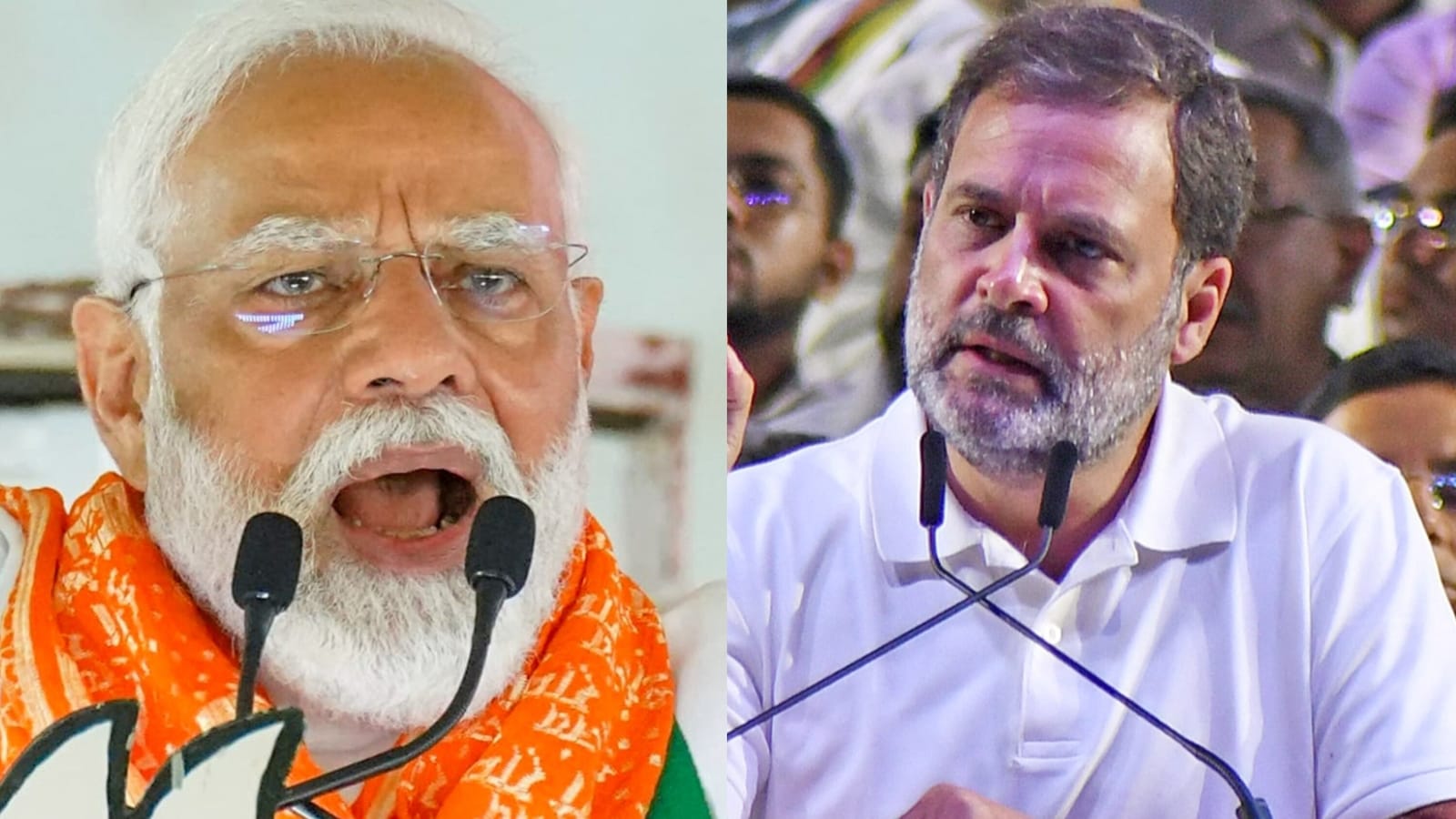
Rahul Gandhi’s “Narender Surrender” comment came at a moment when national unity was imperative. Rather than questioning policy with facts and intent, he chose a phrase that echoed the psychological warfare apparatus of Pakistan’s Inter-Services Public Relations (ISPR). The phrase wasn’t just politically loaded—it was geopolitically reckless. It offered Pakistan a tailor-made soundbite to spin at international forums, distorting the power dynamics of the operation to suggest Bharatiya retreat rather than dominance.
Even more damaging was Gandhi’s claim that External Affairs Minister S. Jaishankar had admitted to “informing Pakistan at the start” of the operation—an assertion proven false by the Press Information Bureau and official defence channels. The message to Pakistan came after the strikes—a well-known diplomatic norm used by responsible states to manage post-conflict escalation, not a signal of hesitation or submission.
A Pattern of Narrative Undermining
This is not the first time Gandhi’s statements have aligned suspiciously close to adversarial talking points. In previous instances—from questioning Bharat’s surgical strikes to casting doubt on the Balakot airstrikes—his remarks have consistently muddied the waters during moments of national assertion. Critics argue this is not just opposition politics, but a pattern that reveals either a serious misjudgment of geopolitical consequences or a tactical gamble to score domestic points at any cost.
The timing of his latest remarks—coming just as Bharat gains moral, military, and diplomatic ground—raises the question: Why choose this moment to distort facts? The answer likely lies in political calculus. With Modi’s approval ratings receiving a post-operation bump and public sentiment consolidating behind his leadership, the Congress party appears cornered. Rather than reinforcing Bharat’s unified voice on the world stage, Gandhi’s comments seem aimed at fracturing it—to undercut Modi, even at the expense of the nation’s diplomatic posture.
National Security Is Not a Battleground for Partisan Spin
At a time when global powers are recalibrating their approach to South Asia, and when Pakistan’s credibility is under international scrutiny, Indian political leaders must recognize the stakes. The language used at home doesn’t stay within borders; it travels, it is quoted, it is weaponized. International outlets often pick up soundbites without context, and when they do, the implications are profound.
Gandhi’s phraseology not only misleads Bharatiya citizens—it misinforms global stakeholders. It provides just enough ambiguity for Pakistan to claim that even Bharatiya leaders admit to strategic failure. In such a climate, where perception often shapes policy, such remarks are not mere political opinions—they are strategic liabilities.
Leadership Demands Responsibility, Not Rhetorical Agitation
Rahul Gandhi has the right to question authority. That’s the essence of democracy. But rights come with responsibilities, especially when dealing with issues that impact national security. Inflammatory phrases like “Narender Surrender” may excite the echo chambers of social media, but they weaken Bharat’s collective stance in moments that demand unity, not division.
Words carry weight. They are not just expressions of dissent but reflections of national ethos, especially in a crisis. A senior political leader, especially one with aspirations of national leadership, cannot afford to be careless with statements that may serve Pakistan’s information warfare goals more effectively than their own military briefings.
A Time for Unity, Not Undermining
The challenge before Bharat today is multifaceted—terrorism, misinformation, and geopolitical maneuvering all unfold simultaneously. In this environment, unity in strategic communication is not optional—it is essential. Rahul Gandhi’s recent comments may have been aimed at discrediting the Prime Minister, but their real cost may be borne by the very nation he claims to represent.
At such a critical juncture, when Bharatiya soldiers have risked their lives and Bharat has demonstrated its capacity to hit back hard, domestic political leaders owe it to the country to rise above partisanship. The battlefield is not the place for poll-tested slogans, and the national interest is not a campaign prop. Bharat needs debate, yes—but it also needs discipline.
