
Triumph Marred by Tragedy: RCB’s Victory Parade Turns Deadly Amidst Chaos and Mismanagement

Paromita Das
New Delhi, 5th June: What was supposed to be a historic and jubilant moment for the city of Bengaluru turned into a horrifying tragedy that has left a deep scar on its celebratory spirit. Just a day after Royal Challengers Bengaluru (RCB) claimed their maiden IPL title in a gripping final against the Punjab Kings in Ahmedabad, 11 people lost their lives and dozens more were injured in a stampede at the M. Chinnaswamy Stadium. The momentous victory, years in the making and particularly emotional for star player Virat Kohli, was meant to be a landmark in the city’s sporting culture. Instead, it was overshadowed by avoidable chaos, confusion, and a glaring failure in crowd management.
The events leading up to the tragedy were, in hindsight, a ticking time bomb of miscommunication, inadequate planning, and underestimation of fan turnout. What Bengaluru witnessed was not just an unfortunate mishap—it was the tragic outcome of systemic negligence in managing large public gatherings, particularly in the emotionally charged aftermath of a rare and long-awaited sporting triumph.
The Build-Up: Miscommunication and Mixed Signals
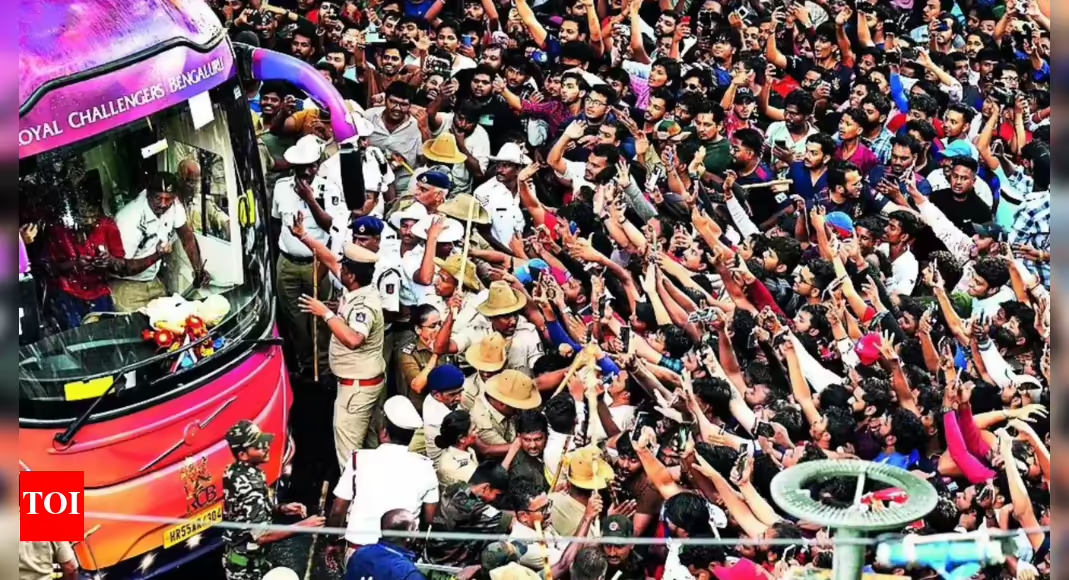
The day began with anticipation and joy as fans flooded into the central business district of Bengaluru, many of them converging on MG Road, Church Street, and the areas surrounding the stadium and Vidhana Soudha. Social media had confirmed earlier in the morning that the RCB team would participate in a victory parade at 5 PM, and fans, many of whom had waited over a decade to see their beloved team lift the IPL trophy, took to the streets in droves.
However, as the day progressed, official communication grew increasingly murky. The Karnataka Home Minister and traffic police announced that the parade was cancelled, citing “security reasons,” only for the RCB’s official handle to contradict this statement a short while later, confirming that the parade would go on as planned. What should have been a tightly orchestrated event quickly descended into confusion. With no clarity on the timing or the form the celebrations would take, fans were left to guess where and when they might catch a glimpse of the team. And when it was finally revealed that the team was being transported in a closed bus, frustration and restlessness built up among the already massive crowd.
The Stampede: Avoidable Chaos
The situation escalated fatally around 4 PM, when thousands had gathered at multiple points—outside Vidhana Soudha and the stadium gates—hoping to participate in the celebrations. Eyewitness accounts describe a sudden surge towards Gate 3 of the stadium, where some believed entry would be granted for the ceremony. With passes made mandatory for entry, and many in the crowd unaware or unable to procure them, tensions rose. More than 15 people were knocked down in the rush, and in the ensuing stampede, 11 were crushed to death. Among the dead was at least one woman, while many others suffered injuries ranging from broken limbs to concussions.
The tragedy was further compounded by a failure to regulate crowd movement. According to official statements, nearly 2–3 lakh people gathered around the stadium area, far exceeding the 35,000-person capacity of Chinnaswamy Stadium. The Karnataka State Cricket Association (KSCA) and state authorities admitted they did not anticipate such an overwhelming turnout. However, this lack of foresight is hard to justify. Bengaluru is one of the most cricket-passionate cities in the country, and RCB, despite years of underachievement, commands a devoted fan base. A maiden IPL title, long coveted and finally achieved, was bound to evoke mass enthusiasm.
Aftermath and Public Outcry
In the wake of the stampede, Karnataka Chief Minister Siddaramaiah expressed condolences and announced an ex gratia payment of ₹10 lakh to the families of the deceased. Free medical treatment for the injured was also assured. A magisterial inquiry has been ordered, though critics argue that reactive measures post-tragedy do little to address the deeper issues of institutional complacency and uncoordinated planning.
Prime Minister Narendra Modi, former Karnataka Chief Minister H.D. Kumaraswamy, and several other political leaders expressed grief and outrage. Kumaraswamy, in particular, criticized the government’s complete failure in crowd control and called for accountability. “The primary reason for this massive tragedy is the lack of proper planning and complete failure to take precautionary measures,” he said.
Meanwhile, fans and citizens voiced their anguish on social media, highlighting the sheer irony of celebrating a sporting victory while being surrounded by grief. Many questioned how celebrations could continue even as emergency services struggled to attend to the injured and carry the deceased from the crowd. The sense of emotional dissonance was perhaps best captured by Virat Kohli’s own reaction. Having dedicated years of his career to the RCB franchise, Kohli posted a solemn message, saying he was “at a loss for words. Absolutely gutted.”
A Tragedy Rooted in Complacency
This heartbreaking incident is more than just a case of unfortunate timing. It reflects a disturbing tendency in Bharatiya public event management—a persistent underestimation of crowd psychology, poor inter-agency coordination, and a reactive, rather than proactive, approach to safety. Bengaluru had every reason to celebrate, but the city’s administrators failed to match the scale of public emotion with adequate logistical planning. The lives lost were not merely victims of a stampede, but casualties of institutional oversight.
What makes this incident particularly distressing is its predictability. The confusion between state departments, contradictory messages from officials and team handles, lack of crowd control infrastructure, and absence of early access control measures all contributed to a scenario that could have been managed—if not entirely prevented.
A Call for Accountability and Change
The triumph of RCB, a team that has long been the symbol of unfulfilled potential, should have been a moment of unifying joy for Bengaluru. Instead, it became a grim reminder of how celebrations can turn deadly when planning fails to respect the scale and sentiment of the people involved.
The 11 lives lost in the chaos deserve more than condolences—they demand accountability. As inquiries begin and political blame games unfold, the real test for Karnataka’s administration lies not just in punishing negligence, but in learning from it. Sporting victories are meant to lift spirits, not crush them. The next time a city celebrates, it must ensure that no cheer is drowned out by cries for help.
