

Paromita Das
GG News Bureau
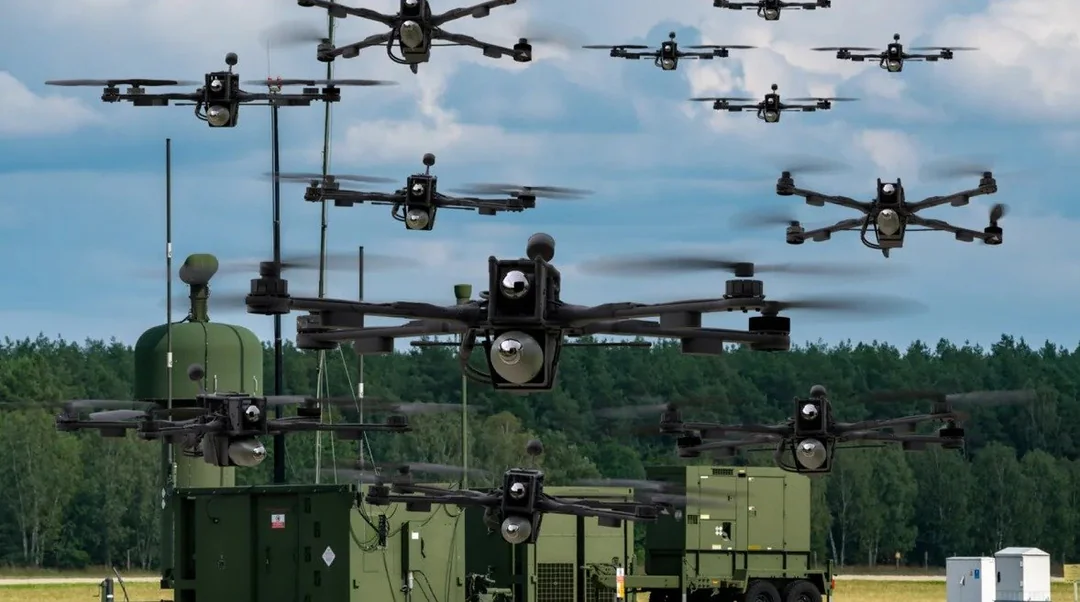
New Delhi, 4th June: Once upon a time, the strength of a nation’s military was measured by the number of tanks it fielded or the roar of its fighter jets slicing through the sky. Today, however, wars are being fought and won by machines with no cockpit, no human heartbeat, and no need for sleep. The future has arrived quietly but decisively—propelled by humming rotors, low-cost parts, and real-time data. The battlefield has shifted from the dogfight in the sky to the silent buzz of a drone hovering just beyond the eye’s reach. And as recent conflicts—from Ukraine to Bharat—show, this transformation is not theoretical. It is fully operational.
Drone warfare is now a reality that cannot be ignored. It is affordable, scalable, and—most critically—disruptive. It has turned militaries upside down, exposed the vulnerabilities of expensive air defense systems, and given asymmetric powers unprecedented leverage. Nowhere is this clearer than in three key theaters of modern war: the Russia-Ukraine conflict, Bharat-Pakistan skirmishes, and the earlier Azerbaijan-Armenia war.
Ukraine-Russia: From Conventional to Unconventional
When Russia invaded Ukraine in 2022, many expected a conventional blitzkrieg with tanks and jets. Instead, Ukraine’s resilience was powered in large part by tactical ingenuity—and drones. The Turkish-made Bayraktar TB2 drones were among the earliest game-changers. Costing less than a cruise missile, these UAVs were used to destroy Russian convoys, air defense units, and even ships. Later, FPV (First Person View) drones, modified racing quadcopters equipped with grenades, emerged as highly effective kamikaze weapons.
The psychological and tactical impact of these drones was staggering. Soldiers feared the sky—not from jets, but from machines no larger than birds. Perhaps the most dramatic proof of drone supremacy came during Operation Spiderweb, when Ukrainian operatives remotely launched drones hidden inside trucks near Russian airbases. They flew under radar coverage and destroyed billion-dollar jets parked on tarmacs. No pilot crossed the border. No missile was launched from foreign soil. Yet the damage was catastrophic and precise. This wasn’t sci-fi—it was strategy in 2025.
By 2024, Russia was reportedly losing over 1,000 drones a month, but so was Ukraine. The difference? Ukraine’s drones were often improvised, crowd-funded, and still effective. A war that once relied on fighter squadrons was being dictated by DIY tech and remote control.
Bharat-Pakistan: A Drone Doctrine Emerges
Bharat’s Operation Sindoor, launched in 2025 after the horrific Pahalgam terrorist attack that killed 26 civilians, marked a watershed in South Asian military dynamics. While Bharatiya missiles struck deep inside Pakistan and in Pakistan-occupied Jammu and Kashmir, it was the use of drones that caught the world’s attention.
Bharat deployed homegrown JM-1 loitering munitions, Heron UAVs, and FPV drones designed for tactical strike missions. Precision mapping of terror camps was carried out using drone reconnaissance before targets were neutralized. Interestingly, decoy drones were also used to mimic fighter jet signatures, confusing Pakistani radar systems and air defense batteries.
In retaliation, Pakistan launched drone swarms—supplied allegedly by Turkey and Iran—toward Bharatiya infrastructure. However, Bharatiya air defenses neutralized most of them, underlining the growing complexity of drone vs. anti-drone warfare.
These exchanges showed that both sides have now integrated drones not just as surveillance assets but as core combat elements. The 2025 skirmishes may be remembered less for airstrikes and more for how two nuclear nations engaged each other through unmanned arsenals.
Azerbaijan-Armenia: The Prototype War
Before Ukraine and Bharat made drones headline material, the 2020 Nagorno-Karabakh conflict between Azerbaijan and Armenia served as the pilot episode of this revolution. Azerbaijan’s use of Bayraktar TB2s and Israeli Harop drones was ruthless and surgical. Armenian tanks, troop positions, and radar systems were taken out with eerie precision. Many of these operations were livestreamed, offering a chilling glimpse into remote-controlled warfare.
What was novel in 2020 has become normalized by 2025. The war offered the first proof that a country with a smaller traditional military could decimate a better-armed opponent using low-cost, high-impact drone operations.
Who Rules the Sky Now?
The global arms race is no longer about fifth-generation jets but about drone fleets. A Bayraktar TB2, costing roughly $1–2 million, can replace a $20 million fighter jet in many combat scenarios. Drones like Iran’s Shahed-136, China’s Wing Loong, and Israel’s Harpy are being exported widely, tilting regional power balances.
Bharat is expected to spend over $3.5 billion on drone capabilities by 2026, while China already deploys AI-enhanced swarming drones. The U.S. and Israel continue to lead in high-end drone warfare, but affordability is now the real superpower.
The Sky Belongs to the Silent
Warfare is undergoing a silent, seismic shift. The heroes of this era are not fighter pilots but engineers, coders, and drone operators. The airspace is being democratized. The cost of projecting lethal power has dropped, but so has the time to make strategic decisions.
Drones have not just changed tactics; they are rewriting the doctrine of war. Countries that fail to adapt risk becoming obsolete on the battlefield. In a future where a village teenager can pilot a deadly drone from a smartphone, national defense will no longer depend solely on steel or soldiers—but on silicon and software.
The age of the drone has arrived, not with a roar, but with a hum. And the battlefield will never be the same again.
