
Farmers’ Movement or Militancy? Farmers’ Arsenal Expands Amidst Escalating Tensions

GG News Bureau
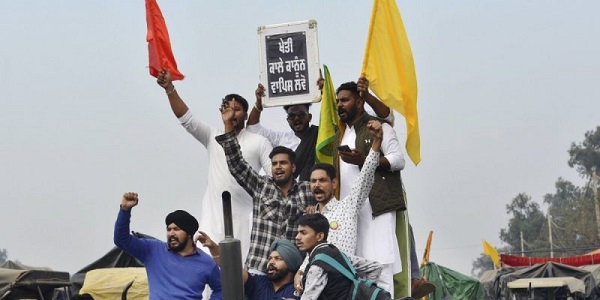
New Delhi, 22nd Feb. Farmers are ready to sabotage the government apparatus. In response to the call for the Delhi March, farmers have arrived at the Shambhu border with machinery to topple the bulkheads, and they are stopping the drones with kites and slingshots. Following the announcement that they would be marching to Delhi, leaders and members of the non-political United Kisan Morcha began strategizing at the border between Shambhu and Khanauri on Tuesday morning. In order to breach concrete and thick barricades, farmers have brought heavy, armored machinery to the Shambhu border. SSP Patiala Varun Sharma arrived at the location at the same time and spoke to the police officers. In addition, plans have been made to handle the emergency situation at the Shubhu border, including medical assistance and emergency beds.
The government’s suggestion was turned down
The government may have offered MSP to quell the farmers’ ‘Delhi Chalo’ movement, but they turned it down. Having rejected the proposal from the Central Government, the farmers plan to visit Delhi once more on Wednesday. The Center’s plan to buy cotton, maize, and pulses at MSP has been rejected by the protesting farmers. Sarwan Singh Pandher, a farmer leader, alerted the central government a few hours later. According to him, “the government will be responsible for whatever happens now.”
https://twitter.com/MeghUpdatesstatus/1760162306162672006?s=20
Why can’t the farmers come to an agreement?
Remarkably, during the fourth round of talks in Chandigarh on Sunday, three Union Ministers—Piyush Goyal, Arjun Munda, and Nityanand Rai—presented a proposal to the farmers. However, this proposal was turned down. Farmers claim that in order for us to back down from our initial demands, the government has offered us a proposal. Nonetheless, the government will bear responsibility for whatever occurs now. Farmers’ movement leaders rejected the Center’s proposal to have government agencies buy cotton, maize, and pulses at MSP for a period of five years. It is not in the farmers’ best interests, he claimed.
Is the farmer’s movement politically oriented?
However, in the middle of all of this, a significant question is raised about how the farmers’ movement suddenly gained traction and how they managed to prepare so thoroughly before going on the streets. In actuality, the largest elections in history will take place in Bharat during the course of the next few months. In the upcoming weeks, the election date will likewise be announced. Political analysts believe that in the general elections of 2024, the National Democratic Alliance, led by the Bharatiya Janata Party, will once again appear to be gaining ground. It was anticipated that the opposition, particularly the Congress, would attempt to set up a situation to hurt the NDA in the approaching general elections given the people’s unwavering faith in Prime Minister Narendra Modi’s NDA government.
Chaos is being created at Shambhu border with JCB & other heavy machineries by so-called farmers.
They are ready with heavy-duty JCB machines & trolleys full of soil to remove all the barriers and enter Haryana via shambhu border. #FarmersProtest2024 pic.twitter.com/SW02auXxwp
— PunFact (@pun_fact) February 21, 2024
Consequently, after two years of protesting at the Delhi borders for nearly 16 months and ending their agitation when the Modi government removed the three agricultural laws, then why now Kisan Sangain has resumed their agitation. In an effort to push for their purportedly unfulfilled demands, the same farmer alliances have now called for another “Delhi Chalo” march.
Revealing the protest’s true purpose
What matters is that the farmers who are supposedly protesting will soon be brought to light. The media claims that on February 14, farmer leader Jagjit Singh Dallewal disclosed the true goal of the farmers’ demonstration.
The report claims that he was overheard stating that Ram Temple is the reason why Prime Minister Narendra Modi’s popularity graph grew and that it should be decreased. In a video he posted on the YouTube channel, Dallewal referenced the altercation between demonstrators and police, claiming it was a sign of PM Modi and the BJP’s demise. Therefore, it is evident that this movement has been planned with political objectives in mind. Farmers’ interests have nothing to do with this.
Since the first day of the protest, there have been constant reports of violence. The Punjab-Haryana border saw around 60 injuries on February 13, including injuries to farmers, law enforcement officers, and members of the media. Following the farmers’ pelting of stones, Haryana Police detained the protesting farmers at the Shambhu border.
The movement of farmers became a significant challenge for the general public as well as the government
Similar to previous protests, the farmers’ protest has grown to be a significant challenge for the public as well as the government. The National Capital Region’s commuters’ everyday routine has been disturbed by the farmers’ agitation. In the NCR, strict guidelines have been announced. As a result, commuters in the Delhi-NCR region must deal with severe traffic congestion. At the borders of Tikri, Singhu, and Ghazipur, police officers have erected several tiers of barricades to stop farmers from marching into the capital. In addition, there has been a negative impact on capital traffic flow.
VIDEO | Farmers' 'Delhi Chalo' march: Tear gas shells fired at Shambhu border. More details are awaited. pic.twitter.com/4TSRuqmZvT
— Press Trust of India (@PTI_News) February 21, 2024
MSP is the primary topic of discussion
Currently, MSP has emerged as the primary topic of discussion in all of the demands made by the farmers during this movement. Whether a government can meet this demand has been questioned by many economists. According to economists, agricultural produce is worth a total of Rs 40 lakh crore (FY20). Products from dairy, agriculture, horticulture, livestock, and MSP crops fall under this category. The entire agricultural produce’s market value is Rs. 10 lakh crore (FY20). Among them are 24 crops that fall under the purview of MSP. A total of Rs 2.5 lakh crore, or 6.25% of all agricultural produce, was purchased through MSPs in FY20. The government will have to spend an extra minimum of Rs 10 lakh crore a year if the MSP guarantee law is implemented. Additionally, Rs 10 lakh crore exceeds the average yearly spending of Rs 67 lakh crore, which was allocated to our infrastructure during the previous seven fiscal years, from 2016 to 2023. As such, this demand cannot be satisfied.
In actuality, Congress has been attempting to increase its vote share under the guise of the farmers’ movement from the outset, even though it is losing elections across the nation. Northern Bharat, particularly Haryana and Punjab, saw a spike in farmer protests in 2020 when Rahul Gandhi organized tractor rallies there from October 4–October 6 to voice opposition to the state’s farm laws. The government was then targeted by anti-India forces who attempted to use this protest as a weapon.
Congress is attempting to gain political leverage from the farmers’ movement
Congress is doing everything in its power to exploit the movement that the so-called farmers initiated for political purposes. In support of the movement, the Congress party declared that, with the opposition’s backing, it will enact a law that guarantees the minimum support price (MSP) for crops. Ironically, this Congress is the same one that had previously rejected this request. The National Farmers Commission of the Swaminathan Committee provided recommendations on MSP through multiple reports between 2004 and 2006. The then-Congress-led UPA government rejected these recommendations, citing “counter-productivity.”
VIDEO | Here's what farmers' leader Sarwan Singh Pandher said at the Shambhu border, where protesting farmers have been stopped by security forces from marching towards Delhi.
"We did not send any youth at the front, instead leaders themselves went peacefully. The way they… pic.twitter.com/8KPkGcXCrK
— Press Trust of India (@PTI_News) February 21, 2024
The head of the Bharatiya Janata Party in the Rajya Sabha, Prakash Javadekar, had questioned the UPA government in 2010 about whether it would implement the Swaminathan Commission’s recommendations for determining the fair prices that should be given to farmers. The written response from KV Thomas, the Union Minister of State for Agriculture, Consumer Affairs, Food, and Public Distribution at the time, stated, “The Minimum Support Price has been recommended by the National Farmers Commission, which is chaired by Professor MS Swaminathan.” (MSP) ought to represent half or more of the production’s weighted average cost, which the Central Government is unable to provide.
Disparity between Congress’s words and deeds
The truth is that Congress frequently makes promises to prioritize the family over the interests of the nation and its advancement in order to win over new members. Congress does not act in accordance with its words. The party-ruled states of Karnataka and Himachal Pradesh are prime examples of this. The party used lofty promises to win elections in both of these states, but it is falling short of the public’s expectations. Likewise, with respect to this purported farmers’ movement, it is evident that the protests by farmers, backed by outsiders and certain political parties, are nothing more than a plot to derail the Bharatiya Janata Party, led by Narendra Modi, in the general elections of 2024.
