

Anjali Sharma
GG News Bureau
UNITED NATIONS, 16th Feb. UN Economic and Social Commission for Asia in a new UN report on Thursday has revealed concerns for the Asia-Pacific region, projected a delay until 2062 to achieve the Sustainable Development Goals.
SDGs adopted by world leaders in 2015, the 17 Goals focus on ending extreme poverty and hunger, ensuring access to clean water and sanitation, and providing quality universal education, among other targets, by 2030.
The 2024 SDG Progress Report, launched by the ESCAP highlighted persisting challenges of poverty and inequality.
Armida Salsiah Alisjahbana, Executive Secretary of ESCAP, wrote in the report’s foreword that our unwavering commitment is vital, as progress towards the SDGs remains uneven and inadequate across the region,”
“While additional efforts are required across the board, granular data emphasizes the urgency of addressing inequalities that impact marginalized groups, including women, girls, rural populations and the urban poor, who continue to find themselves locked out of education and employment opportunities,” she added.
The annual SDG Progress Report provides an overview of progress on the global goals in the Asia-Pacific region, serving as a foundation for activities and policy responses by ESCAP and its partners.
It stressed that Asian and Pacific countries in “special situations” its Least Developed Countries, Landlocked Developing Countries and small island developing States.
The SIDS were the most in need of support given their unique vulnerabilities, ranging from geographical isolation to limited resources and climate change impacts.
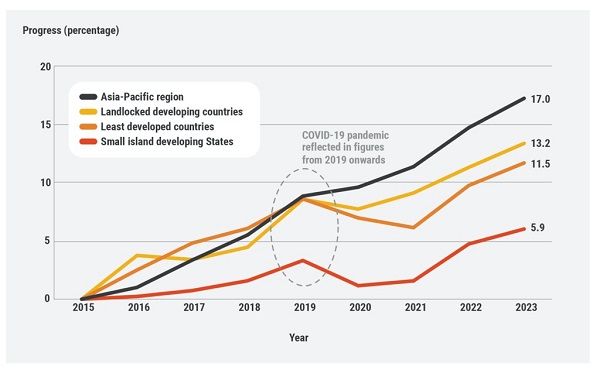
The COVID-19 pandemic all but erased progress these nations made towards the SDGs since 2015, leaving their achievement at a mere 5.9 per cent, according to the report.
The LDCs and LLDCs fared marginally better than the islands, registering only 11.5 per cent and 13 per cent progress, respectively, but still falling significantly short of what is needed to achieve the Goals by 2030.
The report also highlighted the different societal challenges faced by men and women, especially along so-called “gendered” roles.
Women’s challenges primarily related to education and employment. They had lower enrollment rates and struggled on literacy targets.
Young women also encountered difficulties accessing labor markets, leading to higher rates of youth unemployment.
Men’s were more associated with health and personal safety, including new HIV infections, mortality rates attributed to diseases, suicide rates, alcohol consumption, road traffic deaths, mortality attributed to poisoning, prevalence of tobacco use.
People living in rural areas faced pronounced disadvantages, the report noted, such as limited access to basic drinking water and sanitation facilities.
In addition, insufficient clean cooking fuels in these areas contributed to serious respiratory diseases, especially among women and girls who spent longer hours in the kitchen.
In general, urban areas exhibited better conditions, yet paradoxically, within these areas, the poorest boys and girls faced significant hurdles in completing upper secondary education.
The report said that the Goal 13 on climate action required most attention, as progress on all of its targets are off track and some are in reverse.
It underscored the need to integrate climate action into national policies, strengthen resilience and improve adaptive capacity to cope with climate-related disasters, it noted.
The report called for significant ramp-up in investment towards sustainable infrastructure and renewable energy sources.
