

Perspectives of a Needonomist on White Paper
Prof Madan Goel
GG News Bureau
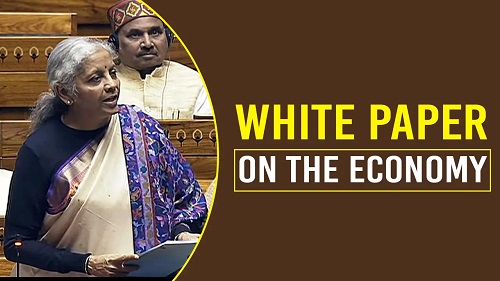
New Delhi, 12th Feb. Being a Needonomist promoting Gita-based needonomics (economics of needs), I consider it my moral duty to say something concrete on the white paper on Indian economy , a 54 page document developed in 90 headings and presented in Lok Sabha by the Finance Minister recently as promised by her during the her speech on Interim Budget 2024-25. It raises some issues to be understood in right perspectives
The white paper on the Indian economy, as presented in the Lok Sabha by the Finance Minister, provides a comprehensive overview of the nation’s economic trajectory and the challenges it faces. Its 54-page length, organized into 90 headings, underscores the complexity and depth of the issues at hand. However, amidst the discourse surrounding it, it’s crucial to steer clear of political rhetoric and instead focus on the agenda for fostering a developed India (Viksit Bharat) towards 2047.
The evolution of India’s economy since 1991, marked by reforms and innovations, has been instrumental in shaping its current state. The recognition accorded to former Prime Minister PV Narasimha Rao with the Bharat Ratna highlights the collective effort of stakeholders, including politicians from both ruling and opposition parties, in this journey.
Despite the progress made, fundamental challenges persist in areas such as education, healthcare, pollution, and employment. Neither the UPA (2004-2014) nor the NDA (2014-2024) regimes have been entirely successful in addressing these issues, partly due to the sheer size of the population and societal apathy.
The period from 2004 to 2014 is characterized by significant mismanagement, despite some commendable initiatives. It’s imperative to approach the analysis of the white paper with an open mind, transcending political affiliations.
Inflation, a critical economic metric, has been inadequately measured and diagnosed, partly due to methodological shortcomings. The NDA government benefited from a favorable global oil market, albeit challenges persist with events such as the Russia-Ukraine conflict.
The fiscal challenges posed by the COVID-19 pandemic were admirably tackled by the NDA government, although the response of the UPA government during the global financial crisis cannot be discounted.
The fiscal deficit, while fluctuating over the years, remains a concern, underscoring the shared responsibility of stakeholders in steering the economy towards sustainable growth.
Several flagship programs initiated by the UPA government, such as GST, Awas Yojana, and Swachh Bharat, have left a lasting impact. However, there’s a notable absence of emphasis on education, particularly higher education, in the discourse.
Education, including higher education, plays a pivotal role in driving economic growth and social development. The dawn of a new era, symbolized by the Amrit Kaal, underscores the imperative of prioritizing educational reforms. Our collective vision of achieving a developed India by 2047 hinges on nurturing a robust education system that empowers individuals and fosters innovation.
We have to understand and adopt needonomics (economics of needs) flowing from the LIC of India logo ‘Yogakshemam Vahamyaham’ (Your welfare is our responsibility) authenticated in Gita ( 9:22) . The simple solution of the challenges and problems faced by us lies in Gita-based needonomics. We must understand Needonomics in totality including needo-consumption, needo-saving, needo-investment, needo-growth, needo-employability, needo-entrepreneurship, needo-trade for glocalization (think globally and act locally) needo-altruism for needo-health, needo-wealth and needo-happiness.
Gita-based thought on Needonomics as Dharma is free from exploitation and individual selfishness whereas religious leaders are free to exploit. The word dharma has roots in the Sanskrit dhr-, which means to hold or to support, and is related to Latin firmus (firm, stable). From this, it takes the meaning of “what is established or firm”, and is “law”. Dharma means “to sustain” or “that which is integral to something” such as dharma of sugar is to be sweet, fire to be hot. Dharma of a teacher is to teach as role model with mind, body and environment ( MBE) under control as management by exceptional (MBE) to be Street SMART (simple, moral, action-oriented, responsive and transparent).
To improve the quality of democracy, we must avoid the war of words on issues of religious intolerance which has no relevance in the science of soul- spirituality (Dharma) which promotes peace and non-violence in all activities including social, political and economic. Gita-based Needonomics (Economics of needs: is to be understood as non-violence in economics. We have to believe that India (as independent, non-violent democracy with integrity and amity) possess sufficient to satisfy our needs and not greed. Therefore, we need to follow spiritually guided materialism (SGM) strategy which is necessary and sufficient to say no to all the socio-economic problems including terrorism and corruption of all kinds spreading hatred, discontent and discrimination in my beloved Bharat- the knowledge seeker economy enjoying the status of Vishav Guru based on Dharma ( not religion).
In addition, it’s crucial for the print media to provide nuanced coverage of economic issues, avoiding sensationalism and political bias. A well-informed citizenry is essential for holding policymakers accountable and fostering informed discourse on the nation’s economic trajectory.
* The writer is former Vice-Chancellor Starex University, Jagannath University and RGNIYD (Govt. of India) known as Propounder Needonomics School of Thought superannuated Professor of economics from Kurukshetra University.
