

Anjali Sharma
GG News Bureau
UNITED NATIONS, 9th Feb. UN head António Guterres on Thursday expressed deep concerns over the situation in Gaza, reiterated his call for an immediate ceasefire and the unconditional release of all hostages.
Guterres was addressing a news conference in New York where he underscored the need for “real, visible, concrete steps” towards a two-State solution based on UN resolutions, international law and previous agreements.
He said “Repeated bloody hostilities and decades of tensions and occupation have failed to provide a State for the Palestinians or security for Israelis”.
“In the Middle East and around the world, we need peace in every sense,” he said.
Guterres said “Our world cannot afford to wait.”
He recalled his address to the General Assembly yesterday, where he presented his priorities for 2024.
Guterres highlighted the ongoing conflicts, geopolitical divisions and escalating polarization within communities and stressed that peace is the “common thread” connecting the multifaceted challenges faced globally.
“Yesterday, I presented a clear-eyed, sober assessment of the world. This is no time for pulling punches,” he said.
He addressed the several “existential challenges” facing the world from nuclear danger to the climate emergency and the risks posed by unchecked artificial intelligence – requires much more to be done across the board.
“It will require a serious conversation between developed and developing countries, between rich and emerging economies, between north and south, east and west,” he stated.
Guterres called for institutional reforms, starting with the overhaul of the Security Council and the Bretton Woods Institutions the World Bank and the International Monetary Fund.
He acknowledged the shift from a unipolar to a multipolar world.
SG emphasized the need for renewed, inclusive mechanisms of multilateral governance to prevent multiplying risks.
Mr. Guterres highlighted the upcoming Summit of the Future in September, noted the importance of the New Agenda for Peace, the SDG Stimulus and the UN’s Advisory Body on Artificial Intelligence.
He emphasized the need of aligning institutions with the present times and preserving principles such as respect for the UN Charter, international law and international humanitarian law.
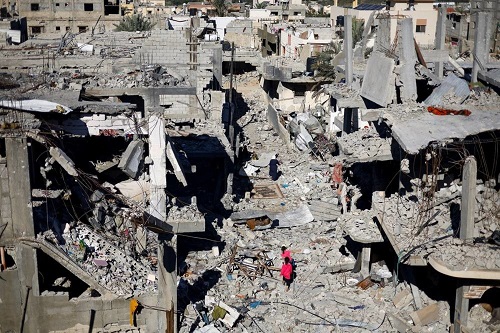
On the immediate Gaza crises, Mr. Guterres expressed particular concern for ongoing conflicts in Ukraine and in Gaza, where “the situation just keeps getting worse” and UN humanitarian operations continue to face denials of access, delays and dangers – including live fire.
“Let’s be clear: Denial of humanitarian access means denial of humanitarian relief for civilians,” he stressed.
He also expressed deep concerns over reports that the Israeli military intends to focus next on Rafah.
“Half of Gaza’s population is now crammed into Rafah. They have nowhere to go. They have no homes and they have no hope,” he said.
He called for an immediate humanitarian ceasefire, unconditional release of hostages and concrete steps towards a two-State solution in line with UN resolutions and international law.
Mr. Guterres concluded by stressing that peace, in every sense, is indispensable for the Middle East and the world.
He emphasized the urgency of action, asserted that the world cannot afford to wait for the necessary changes.
SG said that there is no military solution to the conflict.in Sudan, responded to the situation in Sudan, where rival militaries have been embroiled in a bloody war since April, with devastating consequences for civilians.
He added that the UN is working with the east African regional bloc Intergovernmental Authority on Development, the African Union and the Arab League on a regional approach to the crisis.
Mr. Guterres said that the UN “will go on doing everything we can” for peace in Ukraine based on the UN Charter and on international law when asked a question on the war in Ukraine, which will mark its second anniversary on 24 February.
On missile launches by North Korea and tensions in the region, Mr. Guterres “strongly condemned” the violations of the sanctions and the country’s attempts to launch missiles or develop nuclear weapons.
He said that it is “absolutely essential” that the DPRK abides by the relevant Security Council resolution.
Guterres added that it is “unacceptable” that the Japanese hostages taken by the country have remained in captivity for decades, without any information.
On the expectations for the Summit of the Future Mr. Guterres stated that the UN has presented its proposals and it is up to the Member States to take decisions.
“I would like for the Summit of the Future to approve the key aspects of the New Agenda for Peace”, he said.
He added that he would like to see a more holistic form of prevention and important measures, such as for new kinds of weapons and nuclear disarmament.
SG expressed his hopes for some positive reforms of the Security Council, and “clear indication” about the need reform for the international financial architecture.
“What we want is to gain conscience that our institutions are outdated, and we need to have multilateralism that is much more inclusive and adapted to the realities of today,” he concluded.
