

GG News Bureau
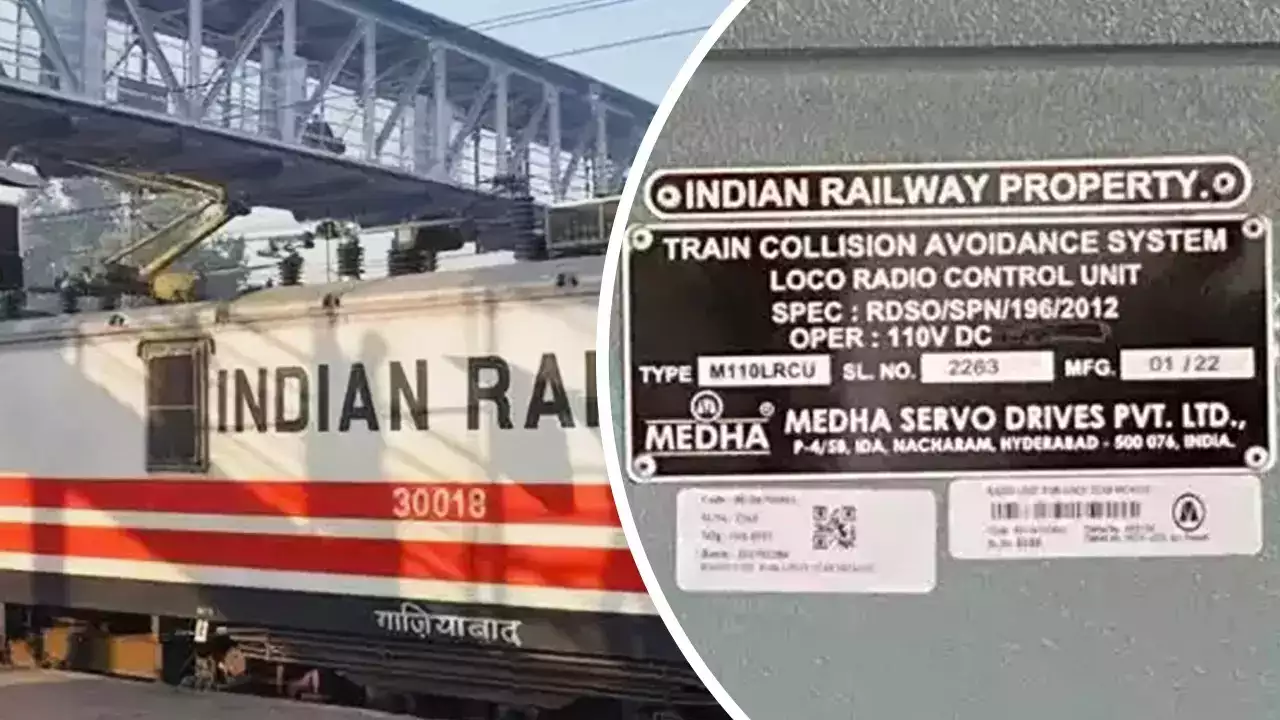
New Delhi, 25th Jan. A recent trial conducted by the North Central Railways Agra Division has shown promising results in examining the braking efficiency of the Kavach anti-train collision system.
The Kavach system, developed by the Research Designs and Standards Organisation (RDSO), automatically applies brakes in case of an emergency when the train driver fails to respond in time.
The Indian Railways plans to implement this system across its network to improve operational safety.
Under the supervision of Kush Gupta, Deputy Chief Signal and Telecommunication Engineer, North Central Railway, a semi-high speed engine, WAP-5, was equipped with the Kavach system and operated at 160 kmph on the Palwal-Mathura section on January 19.
The locomotive was instructed not to apply brakes after observing a red signal ahead, in order to test if the Kavach system would activate and stop the train before the signal.
The trial was successful, with the locomotive stopping 30 meters before the red signal and meeting other safety parameters. WAP-5 locomotives are capable of reaching speeds of 160 kmph and are used in trains like Shatabdi and Gatimaan Express.
The trial, which started at 10 am from Vrindavan in Uttar Pradesh and ended at 1:20 pm in Haryana’s Palwal, will soon be repeated with passenger coaches.
The Agra Division has developed a complete Kavach network on the 80-km stretch between Mathura and Palwal, including the placement of RFID tags on railway tracks, installation of stationary Kavach units at stations, and the installation of towers and antennas along the tracks.
The Kavach system is already operational in three sections on a 1,465-km route and in 139 locomotives in South Central Railway. However, a trial at higher speeds cannot be conducted on that route due to speed restrictions. Since the railways are introducing semi-high speed trains that can reach 160 kmph, it is crucial to test the efficiency of the Kavach system at speeds above 130 kmph.
The Kavach system not only helps train drivers avoid signal passing and overspeeding but also ensures safe and efficient train operations during inclement weather.
