

GG News Bureau
New Delhi, 22nd Jan. This is the moment that has been long awaited by many. The 22nd of January 2024, will go down in the chronicles of history. In the opulent Ram mandir in Ayodhya, the idol of Lord Ram has been dedicated. But in the middle of all of this, we must also never forget the prominent people who spoke loudly for this movement. Another way to put it is that the possibility of erecting a magnificent mandir dedicated to Lord Shri Ram in Ayodhya now exists because of the fire that the aforementioned people started many years ago.
Remarkably, the RSS-BJP had the Ram mandir issue at the top of its agenda during the 1980s. This movement gained momentum after a Tamil Nadu community witnessed a widespread conversion to a different religion. The Bharatiya Janata Party vigorously brought up this subject. The Bhagwa Party has reaffirmed its commitment on multiple occasions by incorporating it into its manifestos for different elections. The Supreme Court gave the green light for the Ram mandir’s building in Ayodhya in November 2019. However, the Ram Janmabhoomi movement became a potent socio-political campaign because of the organizational might of the Bajrang Dal, Vishwa Hindu Parishad, BJP, Rashtriya Swayamsevak Sangh (RSS), and other supporting groups. The Ram temple’s cornerstone was laid by Prime Minister Narendra Modi.
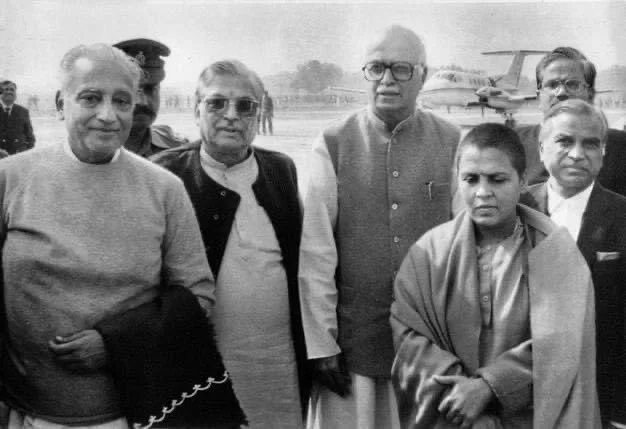
The Ayodhya Ram Janmabhoomi movement has ten prominent faces
Lal Krishna Advani
Renowned BJP leader Lal Krishna Advani became the true ‘poster-boy’ of Hindutva thanks to the Ayodhya Ram Janmabhoomi movement. From the Ram Janmabhoomi site in Ayodhya to the Somnath mandir in Gujarat, he initiated a statewide road show in 1990. He took out Rath Yatra. Advani rallied the populace to support the building of the Ayodhya Ram mandir. But before he ever got to Ayodhya, Lalu Prasad Yadav, the Bihar chief minister at the time, gave the order to have him arrested in the Samastipur area. Two years later, Advani visited the vicinity of the Babri Masjid. On the summons from VHP, he had arrived in Ayodhya. This was the day that Babri Masjid was destroyed. Advani’s criminal prosecution is still ongoing.
Ashok Singhal
One of the most influential Vishwa Hindu Parishad leaders was Ashok Singhal. He had committed his fortune to enlisting the public’s backing for the Ram Janmabhoomi cause. He was considered by many to be the main driving force behind the Ram Mandir movement. He headed the VHP until 2011. He had quit, claiming health issues. In November of 2015, he passed away.
Pramod Mahajan
When it came to the BJP, Pramod Mahajan was on par with Chanakya. He was regarded as the BJP’s chief political strategist under Vajpayee and Adani. On his advice, Advani gave up on his first plan to go on a padyatra from Somnath to Ayodhya. Advani was persuaded to undertake the Rath Yatra by BJP General Secretary Pramod Mahajan in 1990. He also proposed to begin the yatra on September 25, the date of Deen Dayal Upadhyay’s birth, or on October 2, Gandhi Jayanti. Advani decided to start his 10,000-kilometer expedition on September 25. The Rath Yatra was organized and carried out by Pramod Mahajan with assistance from Narendra Modi, who at the time was the BJP’s rising organizational leader.
Uma Bharati
The most significant female leader of the Ram Mandir campaign was Uma Bharti, who served as first term minister and Vice President of the Bharatiya Janata Party. Because of his involvement in the destruction of the Babri Mosque, the Liberhan Commission had found him guilty of instigating the mob. Uma Bharti asserted that Lord Ram is the property of all people, despite attempts by BJP officials to portray Ram Mandir Bhoomi Pujan as a party event exclusive.
Murli Manohar Joshi
In the 1980s and 90s, Murli Manohar Joshi served as the BJP’s “professor.” Joshi Advani and Murli Manohar were present when the Babri Masjid was destroyed in 1992. This is another case where he is on trial. At the time, the country was captivated by a picture of Joshi embracing Uma Bharti following the collapse of Babri Masjid.
Kalyan Singh
Kalyan Singh was the regional satrap of the Ayodhya campaign and also the Chief Minister of Uttar Pradesh at the time. He was sitting in the Chief Minister’s position on December 6, 1992, when Babri Masjid was destroyed. He supported the choice made by the UP administration to refrain from using force to stop the “kar sevaks” from marching towards the mosque. Later, he rebelled to start his own independent organization after failing to receive the backing of the BJP’s top leadership. He was rewarded with the position of governor, nonetheless, after rejoining the BJP.
Sadhvi Ritambhara
During the Ram Mandir campaign, Sadhvi Ritambhara was a fierce leader of Hindutva. She was merely chasing Uma Bharti, who was the campaign’s well-known female face for Ayodhya Ram Janmabhoomi.
Praveen Togadia
Another charismatic leader of the Ram Mandir campaign was Praveen Togadia. His confrontational remarks served as the foundation for his Hindutva persona. He took over as the head of VHP after Ashok Singhal. However, Togadia found himself on the periphery of the Sangh Parivar as a result of Advani’s declining influence inside the BJP.
Viney Katiyar
The charismatic leader of the Bajrang Dal was Vinay Katiyar. In an effort to further the Ram Mandir movement, Bajrang Dal was founded in 1984. Its inaugural president was Katiyar. His political prominence grew after 1992. He was appointed BJP General Secretary. He was a member of the Lok Sabha as well as the Rajya Sabha. He represented Faizabad (now Ayodhya) in Parliament three times as an MP.
Vishnu Hari Dalmia
Precisely interested in Hindutva politics, Vishnu Hari Dalmia was a businessman. His contribution to the push for the building of the Ram temple in Ayodhya was significant. He had a variety of responsibilities at VHP. He was among the co-defendants in the demolition of the Babri Masjid. IAt the age of 91, he passed away at his Delhi home in January 2019.
