

Anjali Sharma
GG News Bureau
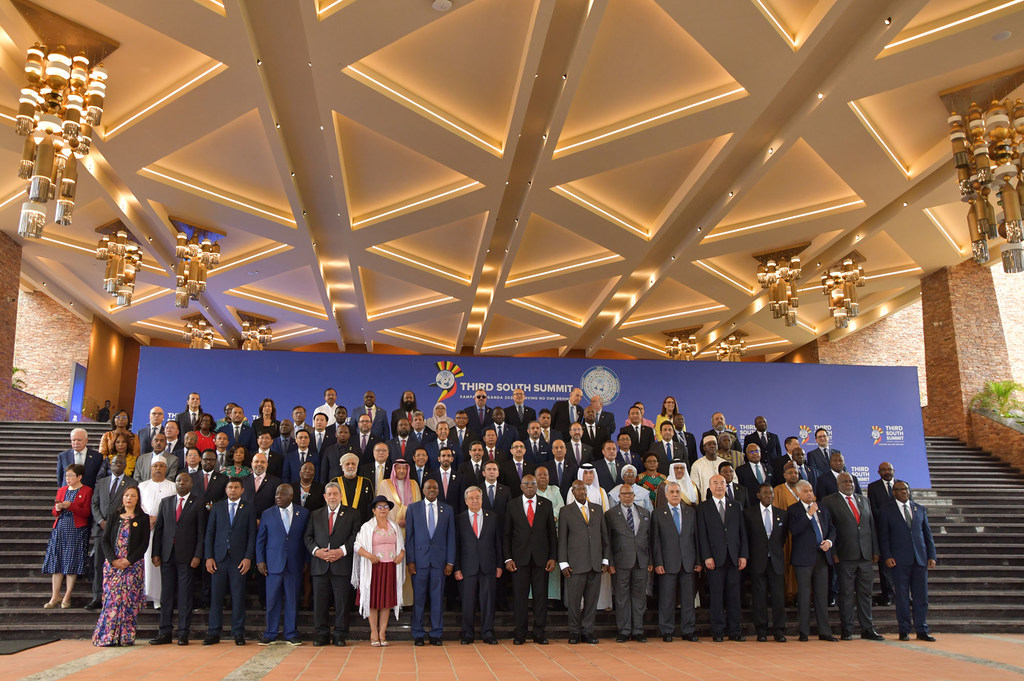
UNITED NATIONS, 22nd Jan. UN chief António Guterres on Sunday said in remarks to the third summit of the Group of 77 and China in Kampala, that developing countries must lead efforts to reform outdated international institutions and frameworks.
He said that over 130 countries are members of the bloc the largest grouping of the global South, represented 80 percent of the planet’s population and their solidarity and partnership are essential to building a sustainable, peaceful, and just world for all.
“Let us face it: those that benefit most from the present global governance system are unlikely to lead its reform. So, momentum for change must come from you,” he told leaders.
He added “I urge you to keep driving these efforts forward.”
Guterres outlined many of the challenges facing the world today, to achieve Sustainable Development Goals by the 2030 deadline and to ensure economic recovery from the COVID-19 pandemic, respect for human rights, and climate action.
“While South-South cooperation is strong and deepening, it does not replace the need for the respect of the commitments of the global North for sustained engagement to reduce poverty and inequality, support growth, and build resilience in developing countries,” he said.
He stressed that peace “is breaking down amidst a climate of global impunity”, with wars in Sudan, Ukraine, the Middle East and beyond devastating lives, fuelling mass displacement, disrupting global supply chains and threatening to set entire regions alight.
SG highlighted the conflict in Gaza, and he warned that “the Middle East is a tinderbox” and urged action to prevent spillover across the region.
He stressed the need for an immediate humanitarian ceasefire, access for humanitarian aid, and the immediate and unconditional release of all hostages.
“The repeated refusal yesterday to accept the two-State solution for Israelis and Palestinians is totally unacceptable, as I told the summit of the Non-Aligned Movement,” he said.
He reiterated that “The denial of the right to statehood for the Palestinian people would indefinitely prolong a conflict that has become a major threat to global peace and security; exacerbate polarization; and embolden extremists everywhere.”
Mr. Guterres said “the current international system is out of date, out of time, and out of step” as it was established when many G-77 countries were still colonized.
“Our troubled world requires effective global action, he declared
He called for reforming the UN Security Council, stated it is paralyzed by geopolitical divisions while its composition does not reflect the reality of today’s world. The global financial system established after the Second World War must also be reformed.
“Yet, amidst all this gloom, there is hope,” Mr. Guterres said.
He pointed to the SDG Summit last year and its strong political declaration, and the Summit of the Future this September provides an opportunity to build on that success.
“It is a chance to create the conditions for countries to achieve the SDGs. And to find consensus on frameworks to address new challenges. And to build a better world for us all,” he said.
He noted that the Summit will also consider deep reforms of the international financial architecture.
Guterres called for the G-77 to unite against climate catastrophe.
He urged members “to hold developed countries to account for climate justice, and for leading an equitable and just transition, based on the phase out of fossil fuel and massive investment in renewable energy.”
Financial commitments made by richer countries also must be met and clarification on the $100 billion promised annually for climate action and doubling adaptation finance by 2025 are mere starting points, he said.
Mr. Guterres added that the Loss and Damage Fund marks a step forward, “we must call for meaningful contributions that have not yet been announced,”.
He expressed hope that the proposed UN Digital Compact will be adopted at the Summit of the Future as new technologies can turbocharge progress toward the SDGs
Guterres added that a newly created expert body has made preliminary recommendations on global Artificial Intelligence governance, including for accelerating sustainable development.
He concluded his address the advisory board is working to ensure scientific breakthroughs are shared equally for the benefit of all people.
