
Ram Temple Images Dominate Ayodhya Landscape, New Bank Office Named ‘Ramjanmabhoomi’ Branch

GG News Bureau
Ayodhya, 20th Jan. Ayodhya is currently immersed in a religious spirit as the consecration ceremony approaches. A new branch of a PSU bank opened on Thursday along the Ram Path and has been named the ‘Ramjanmabhoomi’ branch.
Furthermore, a redeveloped road leading to the Ram temple site has been named Ramjanmabhoomi Path.
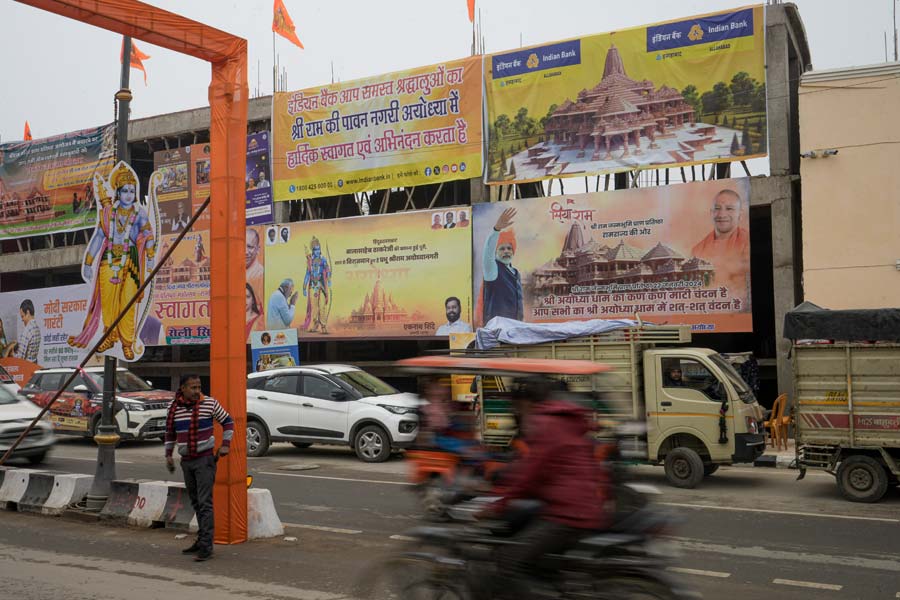
The bank’s branch office, located nearby, has been beautifully decorated with ornate lampposts and canopies. The side walls are adorned with claddings, and a large banner displaying an imposing image of the Ram temple alongside the bank’s name is mounted on the wall.
Close to the redeveloped Ayodhya Dham railway station, another PSU bank has erected a huge hoarding that reads “Ayodhya Nagari mey aapka swagat hai” (Welcome to the city of Ayodhya). The hoarding depicts silhouettes of the Ram temple, the city skyline, and Lord Ram holding his bow.
The devotion to the deity is so strong that even commerce in the holy city is influenced by the spiritual atmosphere. Images of the grand temple can be found on visiting cards, posters, calendars, and even signages.
Almost every company displaying posters in the city has incorporated the Ram Temple in some way or another.
In front of the new railway station building, an advertising firm has put up a call for hiring the space. However, it is not an ordinary advertising space, as it features a graphic image of Lord Ram and the new temple with the hashtag “#AyodhyaKiGarima” (The glory of Ayodhya).
Inside the food plaza of the building, a poster with an image of the temple is displayed behind the counter. Next to it, there is also a poster bearing an image of Lord Ram.
“The entire Ayodhya — including temples, buses, streets, and even mobile phone caller tunes — is immersed in the spirit of Lord Ram,” said Ajitesh Shukla, an employee at a guest house near Asharfi Bhawan.
Public sector undertaking BSNL has put up a poster welcoming people to ‘Prabhu Sri Ram ki Pawan Nagari Ayodhya’ (The sacred city of Lord Ram), near a wall next to the Ramjanmabhoomi Path.
However, it is not just the main thoroughfare like the Ram Path that is adorned with such banners or posters. The image of the temple can be found on the boards of almost all shops, as well as in the lobby spaces of hotels and lodges.
Prabharaj Palace, a lodge that opened a couple of months ago in the Begumpura area, has a large poster of the Ram temple in its lobby.
“Once the temple design was made public, it captured the interest of many people,” said Deepak, a staff member at the lodge. The lobby counter also features a UPI payment barcode panel with a graphic design depicting the ‘Ram ki Paidi’ (Ram’s bathing ghat).
Saryu Lodge, located near Asharfi Bhawan, has also embraced the spirit of Lord Ram. The lodge’s proprietor, Pundarik Gupta, points to the bow and arrow-themed lighting on its rooftop, which illuminates with the words ‘Jai Shri Ram’ (Hail Lord Ram) at night and can be seen from a distance.
His business card displays the image of the new Ram temple, and anyone calling him can hear the tune ‘Ram Aaye Hain Ayodhya Mein’ (Ram has arrived in Ayodhya).
The Golaghat road in front of his lodge features a row of thematic lamp posts with a bow and arrow design on top, and the word ‘Ram’ embossed at the base.
Along the Ram Path, where saffron flags bearing images of Lord Ram and the temple are being sold, the Uttar Pradesh government and other organizations have erected huge banners depicting the Ram temple, along with photos of Prime Minister Narendra Modi and Uttar Pradesh Chief Minister Yogi Adityanath.
Even private firms, seeking to capitalize on the religious fervor of the city, have put up posters carrying the image of the temple, the company’s name and logo, and messages like ‘Aapka Ayodhya Nagari Mey Swagat karta hai’ (Welcomes you to the city of Ayodhya).
