

Anjali Sharma
GG News Bureau
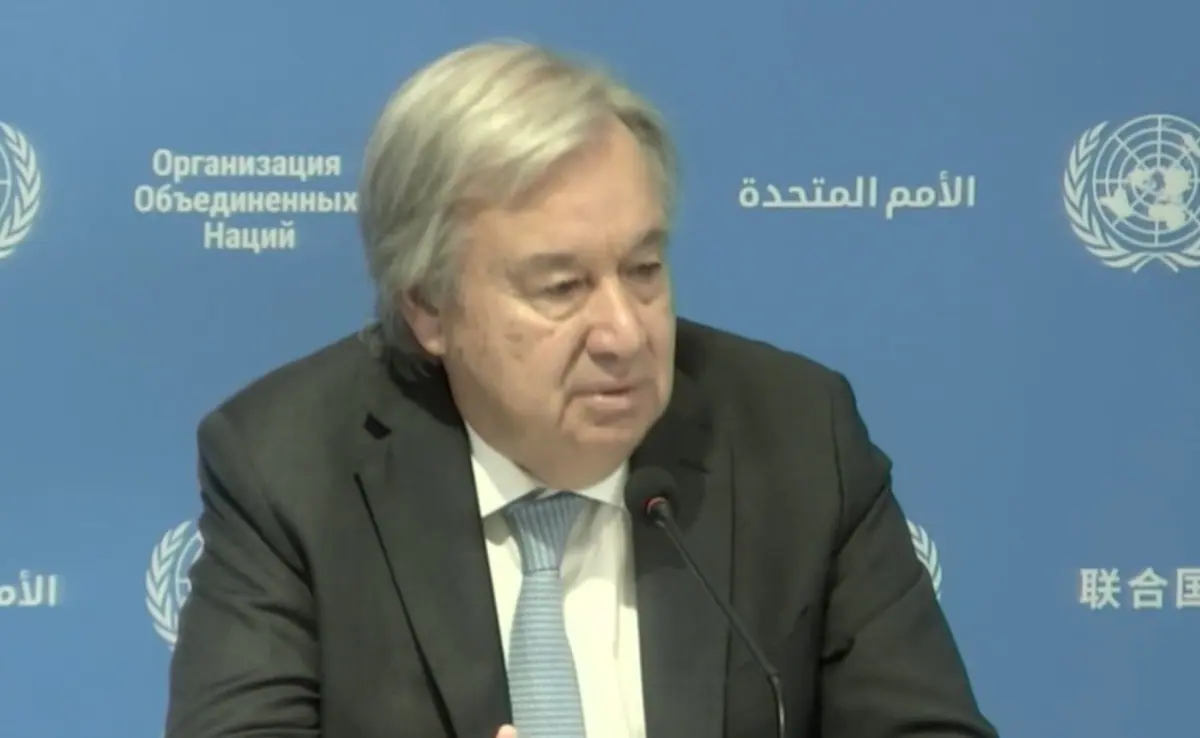
UNITED NATIONS, 18th Jan. UN chief António Guterres on Wednesday said that ongoing conflict in Gaza has sparked regional insecurity and is clear evidence that the international community needs to throw its weight behind a two-State solution in the Occupied Palestinian Territory to resolve the crisis “once and for all”.
He strongly condemned the “barbaric” Hamas-led attacks on 7 October in which 1,200 people were butchered in southern Israel and some 250 taken as hostages, as he was addressing the annual World Economic Forum in Davos.
Mr. Guterres said “spillover” from the conflict in the wider region was “already taking place,” after reports of ongoing heavy Israeli bombardment which has left thousands of civilians dead and prompted repeated warnings from UN humanitarians of potential famine and disease among the 1.9 million people displaced
He stressed that a full fledged confrontation between Israel and Lebanon where rocket and weapons exchanges on the border with Israel have claimed lives “would be a total disaster”.
The escalation “needed to be avoided at all costs”, he said.
He noted the attacks by Houthi fighters in Yemen on ships in the Red Sea had demonstrated that all efforts to date to resolve the Gaza crisis were “not enough”.
Mr. Guterres reiterated “It’s very important to address the humanitarian situation in Gaza, it’s very important to have a humanitarian ceasefire but we need to find once and for all a total commitment of the international community for a two-State solution to exist in Israel and Palestine as the basis for a stable and peaceful Middle East for the benefit of everybody,”.
He explained “The only way for Israelis and Palestinians to live together in security “is if each one of them has a State”.
Guterres stressed the importance of respecting countries’ territorial integrity, in Ukraine’s, after two years of full-scale Russian invasion.
He said “From Russia’s invasion of Ukraine, to Sudan, and, more recently, Gaza, parties to conflict are ignoring international law, trampling on the Geneva Conventions and even violating the United Nations Charter.”
Mr. Guterres noted that geopolitical divisions had become a major threat to the “faltering” global economy.
He called the world leaders and the private sector to prevent further damage to governmental trust and the institutions that form the bedrock of global cooperation, urged them to back reforms of financial institutions “to get the world back on track to safety, prosperity and peace”.
Many of the global ills were the result of disconnect between “the rich, the big and the rest of the world”, he told the World Economic Forum.
He appealed for a “serious negotiation” between industrialized nations and emerging economies that were “drowning in debt”.
Mr. Guterres insisted that nations in the Global South were so crippled by high interest rates that they were unable to future-proof their citizens when implementing the Sustainable Development Goals had never been more important, just many countries remained “hellbent” on raising emissions of greenhouse gases.
“The fossil fuel industry has just launched yet another multi-million-dollar campaign to kneecap progress and keep the oil and gas flowing indefinitely,” he said.
Guterres highlighted how many nations seemed “powerless to work together” to stop the climate threat, while in Switzerland “glaciers are disappearing before our eyes”.
On Big Tech, he urged action against the “serious unintended consequences” posed by Artificial Intelligence, for which like climate change – there was “no effective global strategy”.
Mr. Guterres told the Davos gathering that AI technology offers enormous potential for sustainable development.
He added “but the International Monetary Fund has just warned that it is very likely to worsen inequality.” before laying into technology companies’ pursuit of profit that involved a “reckless disregard” for human rights and personal privacy.
Guterres stressed that the 21st century problems, together with enduring geopolitical divides it was “little wonder” that people everywhere were losing faith “in governments, institutions, and financial and economic systems”, the Secretary-General insisted.
He said the Russian invasion of Ukraine and the Middle East crisis represented serious new threats to global peace and security because they had split the Permanent Members of the UN Security Council in a way that hasn’t been seen for years.
Guterres said he was optimistic that progress on other key areas of global cooperation is possible.
“A lot can be done on the economy, a lot can be done on the climate and a lot can be done on technology” he said, thanks to “a new, multipolar global order with new opportunities for leadership, balance and justice”.
He added that this reformed and inclusive multilateral system was needed to avoid an “epidemic of impunity” that has seen some countries “doing whatever it takes to further their own interests at all costs”, as he railed against “obscene” inequality that has left the world’s richest men earning $14 million per hour.
“At the same time, more than half the world 5 billion people, have become poorer,” Mr. Guterres concluded.
