

GG News Bureau
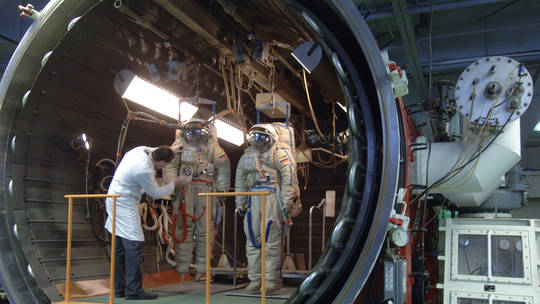
New Delhi, 14th Jan. “Considering the programmatic requirements” for the Gaganyaan programme, ISRO is likely to select space suits manufactured in Russia.
Russian-made suits are probably going to be worn by Indian astronauts on the nation’s first human space mission, “Gaganyaan,” which is expected to take place next year, according to documents obtained by The Hindustan Times.
The decision would probably be made by the Indian Space Research Organisation (ISRO) “considering the programmatic requirements and to doubly ensure the crew safety,” the report states.
India and Russia have been collaborating closely on the $1.4 billion ‘Gaganyaan’ project as part of a number of space cooperation agreements inked by the two nations’ leaders, such as the 2018 agreement on human spaceflight cooperation. India subsequently requested assistance from Russia in a number of ‘Gaganyaan’ programme domains, such as astronaut training, crew modules, and life support equipment.
India’s Prime Minister Narendra Modi said that Russia and his country’s “long association in space is touching new heights” during his 2019 visit to Vladivostok.”
2020 saw the departure of four Air Force pilots chosen by ISRO for training in general space flight at the Gagarin Cosmonaut Training Centre at Star City, Moscow Region. The astronauts have been continuing their mission training in India ever since their return.
An official statement from Glavkosmos, a division of the Russian space agency Roscosmos, stated that the astronauts visited Zvezda, a factory located in Moscow, in September of last year, so that their anthropometric measurements could be measured for the creation of spacesuits. The Hindustan Times was contacted by ISRO experts, but they declined to confirm that Russian suits would be used by Indian astronauts on the voyage. Earlier this month, the space agency’s chief, S Somanath, declared that 2024 will be the “year of Gaganyaan readiness.” The project, which is anticipated to fly in 2025, will see India put its spaceflight capabilities to the test by sending a three-person crew into a 400-kilometer orbit.
It is anticipated that a number of tests will be carried out in the months preceding the launch. This involves an unmanned flight prior to the manned mission and a test flight with the humanoid robot Vyomitra.
In order to prepare for the Gaganyaan, ISRO conducted the first of several test flights in October of last year. When naval divers recovered the mission’s basic crew module from the water, it was upside down. The space agency will test a crew module this year to make sure it stays upright in the event that it splashes down in the ocean.
When the Indian space agency launched its Chandrayaan-3 mission to the Moon’s south pole in 2023, it accomplished a number of historic firsts. The organisation launched Aditya-L1, a solar observatory, as the nation’s first mission to the Sun in September. The mission was successfully launched into orbit last week, and it will conduct observations from there for the next five years. Indian Prime Minister Narendra Modi asked ISRO to seek to establish India’s own space station by 2035 and send the first Indian astronaut to the Moon by 2040, drawing inspiration from the agency’s successful Moon landing in 2016.
This is true even though India has been producing its own Intra Vehicular Activity (IVA) suits for the mission; the outlet stated that the work is almost finished.
