

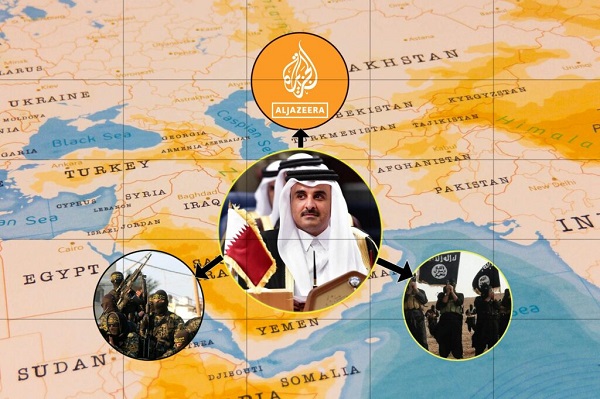
New Delhi, 12th Jan. Qatar has been pursuing a complicated geopolitical strategy, including substantial outreach to Islamist movements in order to establish itself as a dominant voice within the Islamic Ummah.
Qatar’s Multifaceted Strategy
In order to achieve this goal, it has implemented a multi-layered strategy that includes funding for certain Islamic groups. Understanding the rationale behind Qatar’s behaviour requires delving into the underlying geopolitics. Qatar has worked hard over the years to strengthen its connections with China and Pakistan. QatarEnergy, for example, just signed a 27-year contract to export liquefied natural gas to China’s Sinopec. Furthermore, Doha has reportedly invested $9 billion in Pakistan since 2019.
Qatar’s key assets: media networks
The Al Jazeera Media Network (AJMN) is a crucial asset for Qatar in the current geopolitical scene. Established in 1996, this Qatari state-owned media corporation purchased the BBC’s Middle East Bureau and Arabic channel. Al Jazeera, founded in 1997, has been accused of supporting a variety of Islamist groups, including Al Qaeda, ISIS, Osama bin Laden, the Taliban, the Muslim Brotherhood, and Al Nusra. Critics argue that it transmits rebel and terrorist messages, inciting additional turmoil and revolt, while also condemning countries that oppose extreme Islam.
Meanwhile, Qatar has utilised its ownership of the al-Jazeera satellite network to support the Muslim Brotherhood while also attacking and undermining Arab nations. Al-Jazeera’s programming reveals Qatar’s regional objective of supporting terrorist organisations.
Qatar is a small, petroleum-rich Persian Gulf monarchy
Qatar is a small, petroleum-rich Persian Gulf monarchy that houses the United States’ largest military installation in the Middle East. However, for years, it has implicitly agreed to open fund-raising by Sheikh Ajmi and others like him. Following his pitch, which he taped in 2012 and is still available on the Internet, a sports-caster from the government-owned network Al Jazeera praised him. “Sheikh Ajmi knows best” about assisting Syrians, sports-caster Mohamed Sadoun El-Kawary remarked from the same stage.
Sheikh Ajmi’s career as a fund-raiser is one example of how Qatar has long supported a variety of Islamist factions around the region by giving safe haven, diplomatic mediation, financial aid, and, in some cases, weaponry.
Sheikh Ajmi and at least a half-dozen others recognised by the US as private fund-raisers for Al Qaeda’s Syrian affiliate roam freely in Doha, frequently speaking at state-owned mosques and occasionally appearing on Al Jazeera. The state has offered some type of help to the Taliban in Afghanistan, Hamas in Gaza, Syrian rebels, Libyan militias, and Muslim Brotherhood sympathisers throughout the region, whether in the form of shelter, media, money, or weapons.
Qatar has become a hotbed for Islamic jihad
Qatar is now under attack from an odd alliance of interests, including Saudi Arabia, the United Arab Emirates, Egypt, and Israel, all of whom have attempted to paint it as a godfather to terrorists worldwide.
The avalanche of charges against Qatar stems from a regional power struggle in which competing Persian Gulf monarchies have supported opposing proxies in contested areas such as Gaza, Libya, and, most notably, Egypt. Qatar and its Al Jazeera network supported Egypt’s former government, which was governed by Muslim Brotherhood politicians. Other Gulf monarchs have long disliked the Brotherhood, seeing it as a well-organized organisation that could undermine their domestic power, and they supported the military coup that deposed the Islamist ruler.
Qatar publicly offers a base for leaders of the Palestinian militant group Hamas, which is classified as a terrorist organisation by the US and Israel, as well as funds to support its administration in Gaza.
Qatar has permitted Taliban members to build offices and live in Doha, but only as part of arrangements sanctioned by Washington. During Libya’s 2011 rebellion, Qatar funded Rafallah al-Sehati, an Islamist militia in Benghazi with Western-friendly leaders but radicals among its troops.
Now, Qatar is still supporting militias loosely affiliated with the group in their struggle against an anti-Islamist force backed by the UAE.
However, Qatar has also attempted to establish lines, according to Western diplomats and Islamists who have collaborated with Doha. Since the military overthrow of Egypt’s Muslim Brotherhood government, Islamists in exile claim that Qatar has provided them with sanctuary but has refused to contribute funds to the Brotherhood for fear of alienating its gulf neighbours who supported the coup.
During the third Gaza War, known in Israel as Operation Protective Edge, one striking news report in the pan-Arab daily al-Hayat claimed that the Qatari government threatened to evict Khaled Mashaal, the head of Hamas’ political bureau, if his organisation accepted the latest Egyptian cease-fire proposal. Mashaal had fought all diplomatic efforts to end the crisis since mid-July, despite the fact that many of Hamas’ front-line senior commanders in Gaza wanted a cease-fire.
Qatar’s most prominent Islamist relationship is with the Muslim Brotherhood. Qatar has not only supported its Middle Eastern activities, but it has also become one of the main institutional sponsors of the Muslim Brotherhood in Europe. Qatar is accused of financing a Muslim Brotherhood terrorist cell detected in the UAE in 2012.
Undoubtedly, when Saudi Arabia turned against the Muslim Brotherhood in 2002, the Qatari connection became even more significant to the cause. In the aftermath of 9/11, Saudi Arabia’s interior minister, Prince Nayef bin Abdulaziz, gave an interview to the Kuwaiti daily, al-Siyasa, in which he blamed the Muslim Brotherhood for many of the Arab world’s security problems, explaining that while the Saudis had previously provided refuge and support to Muslim Brotherhood activists, Saudi policy would now change. By 2014, the Saudis had officially declared the Muslim Brotherhood a terrorist organisation, with Qatar standing out as its primary supporter.
On the surface, Qatar’s ties to terrorist financing do not make sense. The majority of the emirates along the Arabian coast of the Persian Gulf are recognised to be politically conservative, rather than revolutionary. In contrast to Iran, they are status quo powers. Qatar has also developed extensive defence relations with the United States; since 2003, the forward headquarters of the United States Central Command (CENTCOM) has been based at the al-Udaid air base in Qatar. Nonetheless, Qatar has established relations with some of the most problematic movements in the Middle East. In that way, Qatar’s outreach to Hamas is part of a larger trend in Qatari foreign policy, which has served a wide range of jihadist networks in the Middle East, not only Hamas.
Conclusion
Qatar is interested in capitalising on the Arab Spring’s disarray to promote the Muslim Brotherhood’s goal of overthrowing established Middle Eastern countries. Qatar anticipated that by buying influence in the Muslim Brotherhood network, it would be able to establish a power base with the new Muslim Brotherhood regimes that it expected to arise.
Qatar still sees its massive western neighbour, Saudi Arabia, as its primary danger, thus it is relying on Muslim Brotherhood regimes as leverage against Riyadh.
