

Anjali Sharma
GG News Bureau
UNITED NATIONS, 5th Jan. UN aid coordination office OCHA and teams on Thursday said that they have been unable to deliver urgently needed aid to civilians beyond central areas and north for the past three days. After reports of continued Israeli airstrikes overnight in southern and central Gaza and more rocket fire into Israel from Gaza.
OCHA blamed “delays and denials” along with active conflict for the lack of distribution beyond Wadi Gaza in its latest alert on the deteriorating situation for 1.9 million displaced people in Gaza Strip,
OCHA said in a situation update published late Wednesday “This includes medicines that would have provided vital support to more than 100,000 people for 30 days, as well as eight trucks of food for people who currently face catastrophic and life-threatening food insecurity”.
It stressed that Wadi Gaza has been “severed” from the south for a month, and it reiterated calls for safe, sustained and unhindered access to northern areas of the enclave.
OCHA report stated “The security situation, access, transport and deconfliction remain extremely challenging, especially for hospitals in the northern governorates,” indicated that many of the same physical and administrative obstacles that have hindered previous aid convoys convoys remain in place.
UN human rights chief Volker Türk spoke out on Thursday at reported negotiations between Israeli government officials and third countries to take in Gazans.
“Very disturbed by high-level Israeli officials’ statements on plans to transfer civilians from #Gaza to third countries,” the UN High Commissioner for Human RIghts said in a post on X.
“85 percent of people in Gaza are already internally displaced. They have the right to return to their homes. Int’l law prohibits forcible transfer of protected persons within or deportation from occupied territory.”
According to OCHA, in south of Gaza, Al-Amal hospital and surrounding areas which were shelled on Tuesday left 5 dead, were hit “multiple times” on Wednesday.
It noted latest casualty numbers have not been confirmed from new blasts at and around the Palestine Red Crescent Society-run facility.
WHO confirmed that 13 trucks “carrying crucial medical supplies for surgeries and anaesthesia” had arrived in Gaza since Monday via the Rafah crossing with Egypt.
The aid was due to be delivered to Nasser Medical Complex and three other hospitals in southern Gaza – Al Aqsa, Al Awda and European Gaza hospital – enough for around 142,000 patients.
It highlighted the desperate medical situation throughout Gaza,
WHO reported only 13 out of Gaza’s 36 hospitals are still partially functional; nine in the south and four in the north.
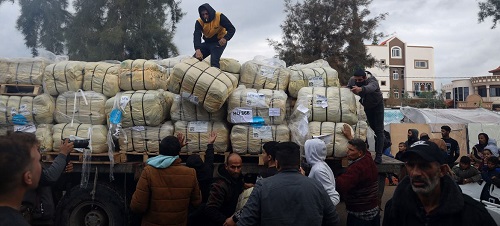
According to OCHA, a total of 105 trucks laden with food, medicine and other supplies entered the Gaza Strip via Rafah and Kerem Shalom crossings on Wednesday.
UN aid update said displaced families continue to need basic supplies, reported “a lack of essential items including children’s clothing, diapers, sanitary pads in the local markets”.
Across Gaza, 1.4 million people are sheltering in 155 facilities run by the UN agency for Palestinians, UNRWA, while Rafah governorate in the far south remains the main refuge for Gaza’s displaced with around one million people crammed in.
UNRWA announced that it will work with UNICEF, WHO, and other partners to deliver over 960,000 doses of vaccines into the Gaza Strip.
The recipients will receive protection against diseases including measles, pneumonia and polio, complementing an earlier immunization campaign by humanitarian partners in late December, involving the delivery of more than 600,000 doses of vaccines to Gaza.
WFP said that it remained imperative to halt the deterioration of health, nutrition and hunger by restoring basic public services to help combat the risk of famine that “increases daily” Gaza’s 2.2 million-strong population who are “in urgent need of food assistance each day”.
