
“$30-Trillion U.S. Market Open for India”: Govt
Tariff cuts, zero-duty access and digital cooperation mark key gains across sectors

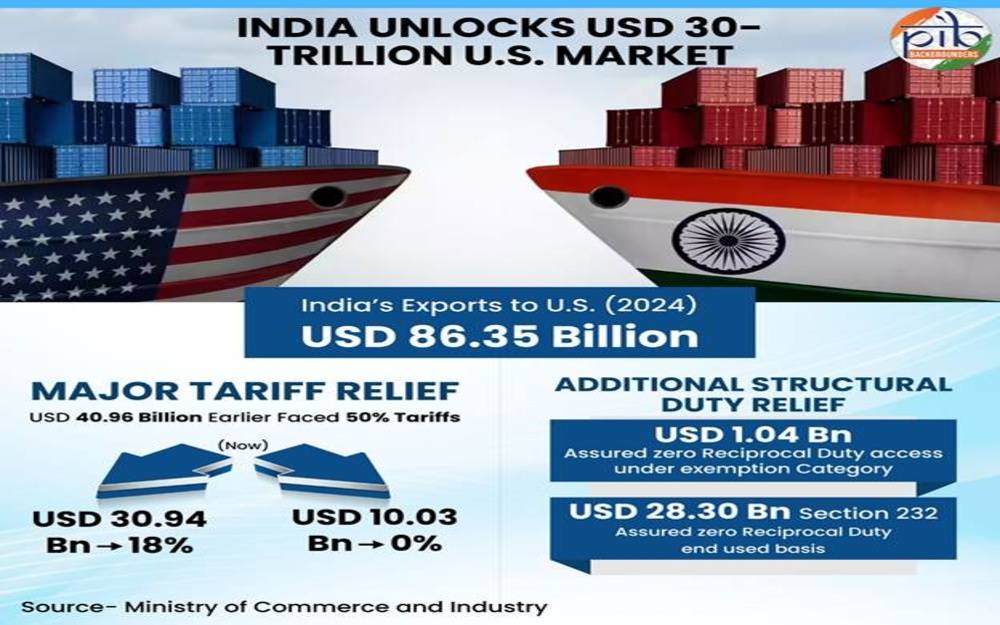
- India secures preferential access to $30-trillion U.S. market
- Tariffs cut from 50% to 18% across key export sectors
- Zero-duty benefits for major agricultural and industrial goods
- Sensitive sectors like dairy and cereals remain protected
GG News Bureau
New Delhi, 9th Feb: India has secured preferential access to a $30-trillion United States market under a new bilateral trade agreement, with sweeping tariff cuts, zero-duty benefits and expanded opportunities across major export sectors, the government said on Sunday.
The agreement restructures tariffs across a wide range of products, enhancing competitiveness for Indian exports currently valued at over $86 billion annually in the U.S. market. Key sectors set to benefit include textiles, leather, gems and jewellery, agriculture, machinery, home décor, pharmaceuticals and technology-driven industries.
Under the deal, tariffs on $30.94 billion worth of Indian exports have been reduced from 50 percent to 18 percent, while another $10.03 billion worth of goods will now enjoy zero-duty access. Agricultural exports worth $1.36 billion will also receive zero additional U.S. duty, covering products such as spices, tea, coffee, nuts, fruits and processed foods.
The government said the agreement creates a tariff advantage for India over competing exporters. While duties on Indian goods have been lowered, several competitors continue to face higher tariffs in the U.S. market, including China at 35 percent and countries like Vietnam, Bangladesh and Thailand at around 19–20 percent.
In the textiles and apparel sector, tariffs have been reduced from 50 percent to 18 percent, with silk receiving zero-duty access in a U.S. market valued at $113 billion. Leather and footwear exports will see similar reductions, opening opportunities in a $42-billion market. Gems and jewellery exports will also benefit from reduced tariffs and zero-duty access for diamonds, platinum and related products.
Machinery exports, currently valued at $2.35 billion, will see tariffs cut to 18 percent, unlocking opportunities in a $477-billion U.S. market. Home décor, toys and other labour-intensive sectors are also expected to gain from the revised tariff structure.
The agreement secures zero additional duty access for $38 billion in industrial exports, including aircraft parts, machinery components, generic drugs and auto parts. It also expands cooperation in semiconductors, digital infrastructure and high-technology sectors.
Officials said the pact balances export growth with domestic safeguards. Highly sensitive sectors such as dairy, meat, poultry, cereals, oilseeds and several fruits remain protected under the agreement. Market access for certain products will be phased over up to ten years, while some sensitive items will be managed through quota systems.
The agreement also focuses on digital trade, quality standards and technology cooperation. India, currently the world’s fifth-largest exporter of digitally delivered services, is expected to benefit from reduced regulatory barriers and improved access to the U.S. digital services market.
The government described the deal as a transformative step that strengthens India’s global trade position while safeguarding farmers, MSMEs and domestic industry, aiming to support long-term export-led growth and deeper integration into global value chains.
