
100 Years, RSS : Mohan Bhagwat Emphasizes Civilizational Oneness, Cultural Origin of Hindu Rashtra

GG News Bureau
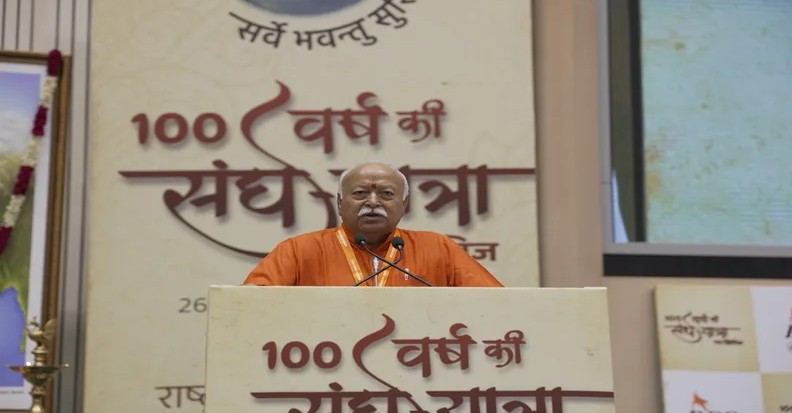
New Delhi, 26th August : Celebrating the centenary year of the Rashtriya Swayamsevak Sangh (RSS), Sarsanghchalak Dr. Mohan Bhagwat gave a strong speech emphasizing the vision of national unity, civilisational continuity, and cultural inclusiveness of the organisation. Addressing the function named “100 Years of Sangh Yatra”, Bhagwat once again emphasized that the DNA of individuals dwelling in across Akhand Bharat (undivided India) has been the same for more than 40,000 years, accentuating the deep-seated civilisational ties cutting across political divides.
A Century of the Sangh’s Journey
Founded in 1925 by Dr. Keshav Baliram Hedgewar, the RSS marks its 100th year in 2025. Over the decades, the organisation has grown from a small shakha in Nagpur to a vast socio-cultural movement, with lakhs of swayamsevaks active across India and abroad. Bhagwat described the centenary as not merely a celebration of longevity, but an occasion to reaffirm the Sangh’s mission of “Rashtra nirman” (nation-building).
“The Sangh is not merely an organisation, it is a movement of character development, discipline, and service,” he told the gathering. “For a hundred years, lakhs of swayamsevaks have worked selflessly for the welfare of society. The true strength of the Sangh lies not in numbers but in its values.”
“Hindu Rashtra – A Cultural Vision”
Responding to controversies surrounding the Sangh’s ideological underpinnings, Bhagwat emphasized that Hindu Rashtra is not to be understood politically. He explained that it is a cultural and civilizational notion based on inclusivity and harmony.
“Hindu is not a word about religion or sect; it is an aura of inclusiveness,” he said. “Hindu Rashtra is a society that coexists with mutual respect, where diversity is not perceived as division. That is our cultural heritage.”
He contended that Hindu civilisation has survived for thousands of years very successfully precisely due to its ability to absorb and integrate differences. “Our ancestors co-existed peacefully for thousands of years, because the core of our civilisation is dharma — the inherent values of truth, compassion, and harmony,” Bhagwat stated.
Akhand Bharat and Civilisational Continuity
In the most dramatic section of his address, Bhagwat emphasized the genealogical and cultural continuity of the Indian subcontinent. “Scientific research has established that for 40,000 years, the DNA of the inhabitants of Akhand Bharat remains identical. We are a single people, one civilisation, irrespective of the artificial divisions of history,” he stated.
He said that although invasions, colonialism, and partition might have transformed political geography, they couldn’t shatter the inherent unity of the people. “We might use different languages, believe in different customs, or even religions, but the cultural core remains the same. The continuity is what makes India strong,” Bhagwat added.
Role of RSS in Modern Society
In the past century, the RSS has transformed from a cadre movement to a network that impacts education, service, politics, culture, and social reform. In the COVID-19 era, swayamsevaks could be seen in relief activities, whereas during natural calamities, they have been first responders. Bhagwat described such work as the essence of the Sangh.
“Sangh does not crave power. Its swayamsevaks work for society in silence — whether that be by education, health facilities, or development of rural areas,” he stated. He also emphasized the need for family values and neighborhood customs as the basis of national prowess.
Inclusivity and National Integration
To reply to critics accusing the RSS of working on the basis of exclusivism, Bhagwat asserted that the vision of the Sangh is rooted in inclusivity. “Every individual residing in Bharat belongs to this country, regardless of religion or community. Hindu Rashtra does not imply exclusion but welcoming everyone,” he stated.
He said India’s international identity is based on its civilizational ethos of “Vasudhaiva Kutumbakam” — the world is one family. “We have not invented this; it is found in our culture for centuries. The world, today torn apart by strife and discrimination, is in greater need of this call of inclusiveness than ever before,” he continued.
Looking Ahead: The Next Century of Sangh
As the RSS marked its second century, Bhagwat asked swayamsevaks to take up the task of nation-building with renewed enthusiasm. He asked them to work with contemporary challenges like technology, environment, and globalisation while retaining cultural roots.
“There is still a long way to go for our work,” Bhagwat added. “The next century should be one of self-reliance, social cohesion, and world leadership by Bharat. To achieve that, every swayamsevak should imagine themselves not only as Sangh members, but as servants of society.”
